Saint
Saint Benedict Joseph Labre
Pilgrim and beggar, Rome, 1748-1783
Early life
Benedict Joseph Labre was born at Amettes, in France, on 26 March 1748, the first of fifteen children.[1] Later he was able to enter the Certosini, whom he left almost at once, and then the trappisti, whom he also had to leave because of serious illness.[1] Free again, he set out on pilgrimage to Rome, according to a vow made during his convalescence; on the journey he received an inner light about his vocation so vivid that he never doubted it again.[1]
Pilgrimage
Nicknamed 'the vagabond of God', he decided that the road would be his monastery.[1] With crucifix and breviary he went as a pilgrim through France and Italy, living on charity that he shared with others.[1] He wore only a poor, torn garment and ate only the food he received as alms.[1]
Death and recognition
He spent his last 6 years in Rome, where he died in 1783.[1] He was beatified on 20 May 1860 by Pope Pius IX.[1] He was canonised on 8 December 1881 by Pope Leo XIII.[1]
Follow the evidence
Sources and notes
- Benedetto Giuseppe Labre
Dicastery for the Causes of Saints · Italian
Accessed 2026-09-05
Editorial notes
Translated and condensed from the Dicastery's official Italian profile by an automated pass on 2026-09-09; identity matched on the death date and name; editorial review pending.
This is an AI-assisted draft prepared from the sources above. Its citations identify its evidence; they do not replace a historical review.
The inherited biography
The earlier biography for this record.
Read the inherited biography
Saint Benedict Joseph Labre, also known as the Beggar of Perpetual Adoration, was born as Benedetto Giuseppe Labre on March 25, 1748, in Amettes, Boulogne, France. Despite being born into a prosperous middle-class family and receiving a proper education under the guidance of his uncle, a parish priest, Benedict's life took an unexpected turn as he dedicated himself to a life of poverty, wandering, and perpetual adoration in Rome, Italy. Today, he is recognized as a patron Saint of the mentally ill, homeless, rejected, and pilgrims. Early Life and Education: Benedict Joseph Labre was the oldest of fifteen children born into a comfortable middle-class family. At a young age, he displayed a genuine piety and devout nature. After the death of his uncle, who was his mentor and educator, Benedict's desire to pursue a religious life intensified.
He sought admission into various religious orders, including the Trappists, Carthusians, and Cistercians. However, due to different reasons, he was rejected by all of them. Years of Wandering and Perpetual Adoration: Undeterred by the rejections, Benedict Joseph Labre embarked on a journey across Europe, spending several years in complete poverty. His wanderings primarily centered around Rome, Italy, where he found solace in cathedrals and dedicated himself to perpetual adoration. Benedict was deeply devoted to Christ's Passion, often experiencing religious ecstasies while contemplating the crown of thorns. These mystical experiences were said to have been accompanied by reports of him floating, soaring, and even bilocating during these trances. Life as a Beggar and Miraculous Acts: Living as a beggar, Benedict Joseph Labre relied on the alms of others for his sustenance.
If he was given more than he needed for the day, he generously shared the remainder with those who were in greater need. Despite his destitute state, he possessed a strong faith, compassion, and the ability to heal others. Numerous accounts tell of Benedict's ability to miraculously cure his fellow homeless individuals and even multiply bread to feed them. His reputation as a counselor grew as people of all walks of life sought his guidance and solace, recognizing him as a holy and wise figure. Final Days and Miraculous Legacy: Benedict Joseph Labre spent his final days in a hospice in Rome, his body exhausted from a life of extreme austerity. On April 17, 1783, he passed away, leaving behind a profound legacy of spiritual devotion, selflessness, and humility.
His confessor, Marconi, wrote a biography detailing 136 miraculous cures attributed to Benedict within three months of his death, a testament to his extraordinary holiness and closeness to God. Canonization and Patronages: Recognizing his remarkable virtues and the impact of his life, Benedict Joseph Labre was beatified by Pope Pius IX on May 20, 1860, and canonized as a Saint by Pope Leo XIII on December 8, 1881. He is now venerated as a patron against insanity, mental illness, bachelors, beggars, hoboes, homeless people, mentally ill people, people rejected by religious orders, pilgrims, tramps, and unmarried men. Representation and Feast Days: Saint Benedict Joseph Labre is often depicted as a beggar wearing a tri-cornered hat, sharing his alms with those in need.
Additionally, he is also commonly represented in the act of perpetual adoration. His feast day is celebrated on April 16th each year, commemorating his remarkable life and inspiring example of selfless devotion to God and compassion for the marginalized. Conclusion: Saint Benedict Joseph Labre's life serves as a testament to the transformative power of faith, selflessness, and devotion to God. Despite facing rejection and living in extreme poverty, he found solace in perpetual adoration and became a source of spiritual guidance and miraculous healings for many. Today, he continues to inspire and intercede for those facing mental illness, homelessness, and rejection, reminding us of the value of compassion, perseverance, and unwavering faith in God's providence.
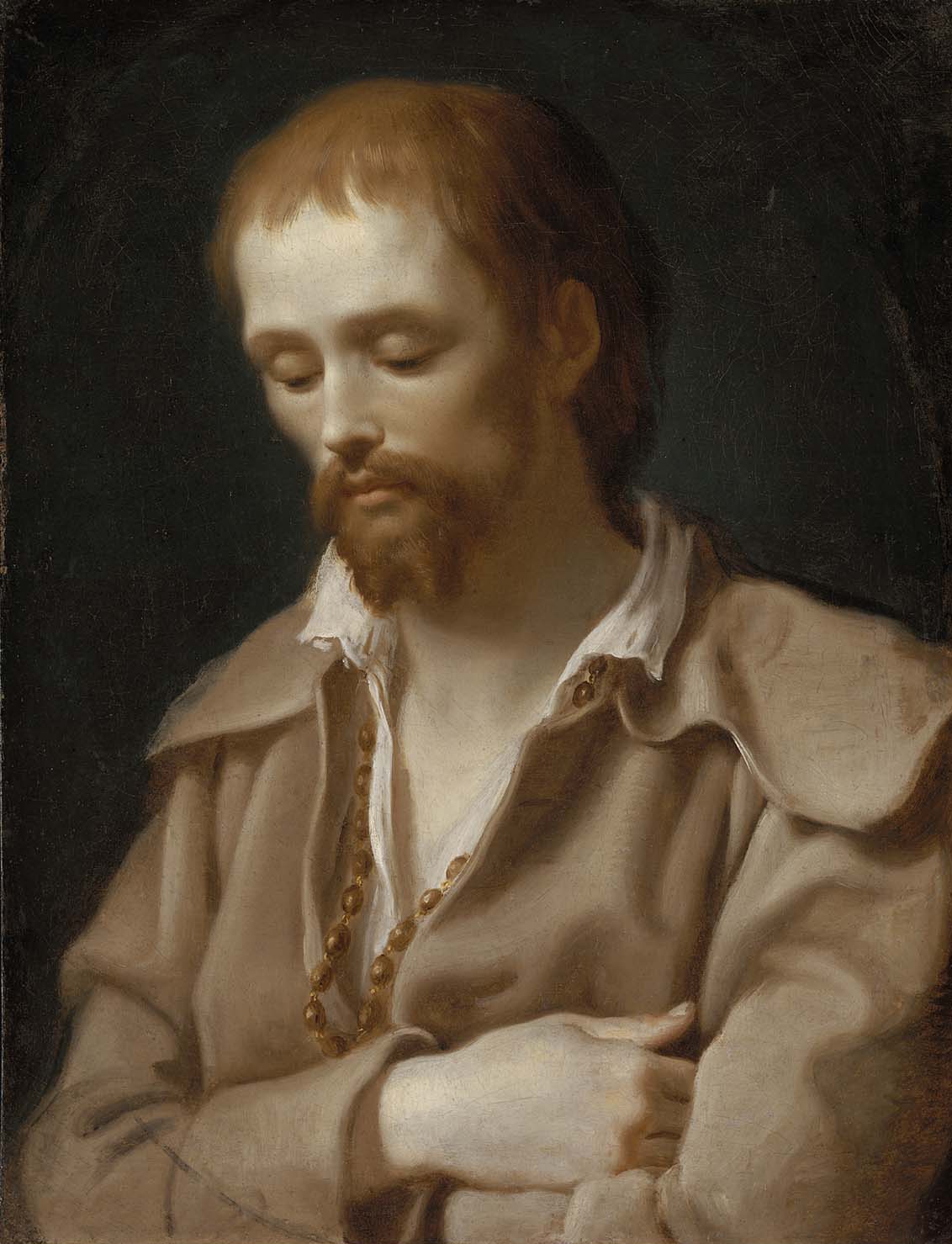
Image: Public domain via Wikimedia Commons (Cavallucci - San Benedetto Giuseppe Labre.jpg)
Know of a grace or miracle attributed to Saint Benedict Joseph Labre?
Report a Grace or Miracle