Beato
Beato Franz Jägerstätter
Farmer, husband and father, martyr, St Radegund, Upper Austria, 1907-1943
Early life
Franz Jägerstätter was born on 20 May 1907 in St Radegund, Upper Austria, to his unmarried mother, Rosalia Huber, and to Franz Bachmeier, who was killed during World War I.[1] After the death of his natural father, Rosalia married Heinrich Jägerstätter, who adopted the boy and gave him his surname in 1917.[1] He received a basic education in the village's one-room schoolhouse, his step-grandfather helped with his education, and he became an avid reader.[1] In his younger years he was, it seems, unruly, and was the first in his village to own a motorcycle.[1]
Faith and family
After his marriage to Franziska in 1936 and their honeymoon in Rome, he grew in his faith.[1] Besides his farm work he became the local sexton in 1936 and began receiving the Eucharist daily, refusing the customary offering for his services at funerals.[1] In 1938 he was the only local citizen to vote against the 'Anschluss', the annexation of Austria by Germany, though he was neither a revolutionary nor part of any resistance movement.[1] He was called up for military service and sworn in on 17 June 1940, was allowed to return to the farm thanks to the intervention of his mayor, and was later in active service from October 1940 to April 1941.[1] He became convinced that participation in the war was a serious sin and decided that any future call-up had to be met with his refusal to fight.[1]
Martyrdom and recognition
In February 1943 he was called up again; he presented himself at the induction centre on 1 March 1943, announced his refusal to fight and offered to carry out non-violent services, which was denied him.[1] He was held in custody at Linz in March and April, transferred to Berlin-Tegel in May, and tried on 6 July 1943, when he was condemned to death for sedition.[1] On 9 August, before being executed, he wrote that neither prison nor chains nor sentence of death could rob a man of the Faith and his free will.[1] He was beatified by Pope Benedict XVI on 26 October 2007.[1]
Siga la evidencia
Fuentes y notas
- Franz Jägerstätter
Dicastery for the Causes of Saints · italiano
Consultado el 2026-09-05
Notas editoriales
Translated and condensed from the Dicastery's official Italian profile by an automated pass on 2026-09-09; identity matched on the death date and name; editorial review pending.
Este es un borrador asistido por IA preparado a partir de las fuentes anteriores. Sus citas identifican la evidencia; no sustituyen una revisión histórica.
La biografía heredada
La biografía anterior de este registro.
Leer la biografía heredada
Beato Franz Jägerstätter, también conocido como Franz Jaegerstaetter, nació el 20 de mayo de 1907 en Sankt Radegund, Oberösterreich, Austria. Nació de Rosalia Huber y Franz Bachmeier, quienes eran ambos sirvientes y demasiado pobres para casarse. Trágicamente, el padre de Franz falleció en la Primera Guerra Mundial cuando Franz era apenas un niño. Tras la muerte de su padre, su madre se casó con el granjero local Heinrich Jägerstätter, quien adoptó a Franz y lo crió como propio.
Aunque Franz tuvo una educación formal limitada, su padre adoptivo Heinrich se comprometió a asegurar que pudiera leer y educarse por sí mismo. Franz trabajó en la industria del mineral de hierro durante tres años a partir de los veinte años. Durante sus primeros años de veinte, llevó una vida algo temeraria y disoluta. Sin embargo, a finales de sus veinte años, decidió establecerse y abrazó una vida como agricultor campesino. En ese momento, Franz también se comprometió profundamente con su fe, se casó y se convirtió en el amoroso padre de tres hijas.
Franz sirvió como sacristán de su parroquia, cuidando de los servicios funerarios y de oración. Dedico totalmente su vida a su fe, asistiendo a misa diariamente y desarrollando un ministerio especial para apoyar a los afligidos. Franz se hizo conocido por su crítica vocal a los nazis, destacando como la única persona en su aldea que votó en contra de la unificación de Austria con Alemania en 1938. En respuesta al saludo nazi omnipresente "Heil Hitler", Franz respondió famosamente con "Pfui Hitler". Debido a sus creencias inquebrantables, Franz experimentó aislamiento social dentro de su propia comunidad.
Cuando fue reclutado en el ejército del Tercer Reich, Franz enfrentó un profundo conflicto entre su servicio militar y su fe. Después de servir brevemente en la retaguardia, tomó la valiente decisión de rehusar cualquier otro servicio militar. Como resultado, fue arrestado y encarcelado tanto en Linz, Austria, como en Berlín, Alemania. Sufrió un juicio militar y finalmente fue ejecutado mediante decapitación en Brandenburg an der Havel el 9 de agosto de 1943.
Durante su tiempo en prisión, Franz se volvió a la oración, apoyó a los compañeros presos y compuso una serie de cartas y ensayos conmovedores. A pesar de los riesgos, permaneció firme en su convicción de que era incompatible con su fe servir en el ejército nazi. Su valentía moral y compromiso inquebrantable con sus principios lo marcaron como un verdadero mártir.
Reconociendo su martirio, el Papa Benedicto XVI declaró a Franz Jägerstätter venerable el 1 de junio de 2007. Más tarde aquel mismo año, el 26 de octubre de 2007, el Papa Benedicto XVI beatificó a Franz, otorgándole el título de Beato Franz Jägerstätter.
Hoy, Franz Jägerstätter representa un ejemplo resplandeciente de fe inquebrantable, integridad moral y resistencia firme ante la injusticia. Su vida y sacrificio continúan inspirando y desafiando a las personas para resistir el mal y permanecer fieles a sus creencias, incluso en las circunstancias más difíciles.
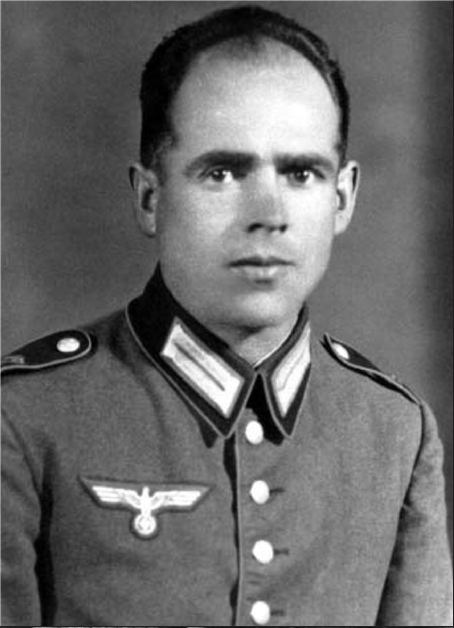
Imagen: Public domain via Wikimedia Commons (Franz Jägerstätter in a Wehrmacht uniform (ID photo).png)
¿Conoces una gracia o milagro atribuido a Beato Franz Jägerstätter?
Reportar una Gracia o Milagro