✠
Félix Varela
1788–1853
“There is no authentic fatherland without virtue.”
Path to Sainthood
Servant of God
1983
Venerable
2012
Blessed
Saint
The Man Who Taught Cubans How to Think
Félix Varela y Morales was born in Havana in 1788 and, orphaned young, spent part of his childhood in St. Augustine, Florida, where his grandfather commanded the Spanish garrison. Ordained in Havana in December 1811, he became one of the most influential teachers in Cuban history, holding the chair of philosophy at San Carlos Seminary and writing texts used across the Spanish-speaking world. The Cuban intellectual José de la Luz y Caballero said of him: as long as there is thought in Cuba, we will have to remember him, the one who taught us how to think.
Elected in 1821 to represent Cuba in the Spanish Cortes, Varela argued for the abolition of slavery and self-government for Spain’s colonies. When Ferdinand VII regained absolute power, Varela was condemned to death and fled in 1823 to the United States.
He spent roughly three decades in New York, serving at St. Peter’s on Barclay Street, founding Christ Church on Ann Street and later the parish that became Transfiguration, and rising to Vicar General of the Diocese of New York in 1837. He was a tireless pastor to poor Irish immigrants through the cholera epidemics and founded newspapers including El Habanero, the first Spanish-language newspaper published in the United States, remaining from exile the intellectual father of Cuban independence.
Broken in health by asthma, he retired in 1848 to St. Augustine, where he died in poverty in February 1853. His remains were moved in 1902 to the University of Havana. His cause, opened in 1983 under the Archdiocese of Havana with strong Archdiocese of New York involvement, culminated in the decree of heroic virtue signed under Pope Benedict XVI on March 14, 2012, announced at St. Patrick’s Cathedral on Easter Sunday of that year.
In His Own Words
“There is no authentic fatherland without virtue.”
- Attributed to Varela; quoted by Archbishop Thomas Wenski of Miami
Timeline
The Cause of Father Varela
The cause of Venerable Félix Varela is carried by the Archdiocese of Havana and promoted by the Archdiocese of New York, where he served immigrants for thirty years. An alleged miracle has been under study.
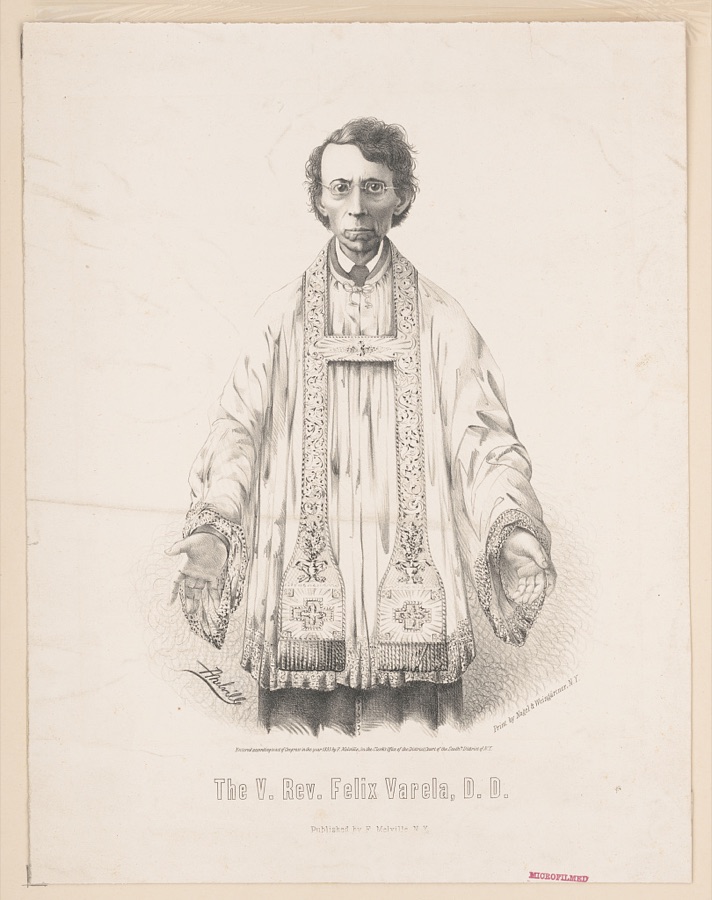
Venerable Félix Varela
The V. Rev. Felix Varela, D.D. (Nagel lithograph, c.1853; Library of Congress)
0
Supporters
0
Prayers
Born
November 20, 1788
Havana, Cuba
Died
February 1853
St. Augustine, Florida
Venerable
March 14, 2012
Decree under Benedict XVI
Ministry
~30 years in NYC
Vicar General of New York
Explore more saints and blesseds