Santo
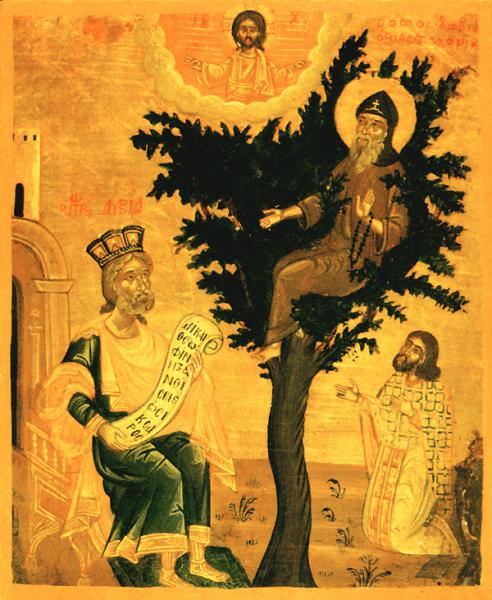
Saint David the Dendrite
Among the vast tapestry of ascetics who sought the face of God in solitude, one figure stands out for the sheer duration of his confinement.
Biografía
Esta biografía está disponible actualmente solo en inglés.
Among the vast tapestry of ascetics who sought the face of God in solitude, one figure stands out for the sheer duration of his confinement. For approximately eighty years, a man known as the Dendrite remained locked within a small cell situated beyond the ancient fortifications of Thessalonica. This extraordinary feat of endurance defines the legacy of this hermit, whose life was measured not in days or years, but in a single, unbroken station of prayer and penance. The story of Saint David the Dendrite is one of radical stillness in a world defined by motion, a testament to a spirit that found its freedom not in wandering, but in total surrender to the divine presence within the four walls of his dwelling.
The setting of his ministry was the bustling port city of Thessalonica in Greece. While the world outside the city walls moved through the rhythms of commerce, political upheaval,
and daily labor, the hermit remained stationary. He did not wander the deserts of Egypt or the mountains of Syria; instead, his entire world was reduced to the confines of his dwelling. To spend eighty years in such a space requires a discipline that transcends physical capability. It speaks of a spirit that found its freedom not in movement, but in total surrender to the divine presence within the four walls of his cell. The specific era of his life remains obscure, though the historical context of Thessalonica as a center of early Christian fervor suggests a time when such radical asceticism was a recognized path to holiness.
The epithet by which he is known, the Dendrite, serves as a marker of his distinct path. While the literal meaning of the title often implies a connection to trees or forest dwelling, the historical record for this particular saint highlights the stone enclosure. Tradition associates this title with those who dwell among the woods, yet the primary fact recorded is his confinement in a cell. Whether the cell was nestled within a grove or stood isolated against the earth, the name serves as a unique identifier. He was not a wandering ascetic; he was a rooted presence, a fixed point of prayer in a city of motion.
Historical context regarding Thessalonica places it as a major hub of the Eastern Roman Empire, steeped in religious significance. For a hermit to choose a spot outside the walls to dedicate eight decades to God is a testament to the spiritual hunger of the region. While specific dates of his birth and death are lost to the mists of time, the duration of his seclusion is recorded with clarity. This longevity is the core of his hagiography. The record does not detail specific miracles of healing or exorcism attributed to him, but the miracle of his life was his own existence.
To the faithful, the Dendrite represents the ultimate form of stability. In an age where many monks sought the perfection of the desert through movement, he found perfection through stillness. The eighty years of confinement were not a punishment, but a voluntary offering. He locked himself away from the world, not out of hatred for humanity, but out of a desire to serve it through intercession. His cell became a spiritual anchor for the city, a hidden sanctuary where the noise of the streets could not reach the silence of the soul.
His story is a reminder that holiness does not always require grand gestures. Sometimes, it is found in the quiet endurance of a locked door, the dust of a cell, and the unceasing prayer of a heart fixed on heaven. Though little is known of his personal history, his life stands as a monument to the power of sustained devotion. The silence he maintained for eight decades speaks louder than words, offering a profound witness to the belief that the Kingdom of Heaven is accessible through the surrender of the self.
También se celebran el 26 de junio
¿Conoces una gracia o milagro atribuido a Saint David the Dendrite?
Reportar una Gracia o Milagro