Santo
Saint Kevin
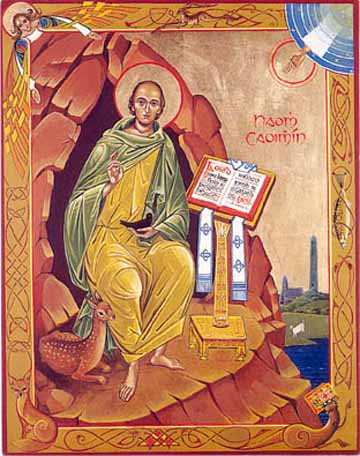
The rugged landscape of Glandáloch in Ireland stands as a testament to a spiritual legacy forged in solitude and devotion.
Biografía
Esta biografía está disponible actualmente solo en inglés.
The rugged landscape of Glandáloch in Ireland stands as a testament to a spiritual legacy forged in solitude and devotion. While the precise chronology of his life remains obscured by the mists of early history, one figure emerges with undeniable prominence from the annals of the Irish Church: the founder and abbot of the monastery of Glendalough. Here, amidst the glacial valleys and lakes of the Wicklow Mountains, a community was established that would become a beacon of learning and piety, guided by a man known as the spiritual father to its inhabitants.
The historical record regarding this holy man is notably sparse, a common characteristic of many figures from the early medieval period. There are no definitive dates of birth or death that can be cited with absolute certainty, and specific biographical details of his youth are largely lost to time. Yet, what is known is of profound significance. He is recognized primarily through his foundational work. At Glandáloch, he established a monastery that served not merely as a religious house, but as a center of communal life. As the abbot, he assumed the heavy burden of leadership, acting as the shepherd to a flock of monks and laypeople who sought refuge and instruction within the valley.
In the context of early Irish monasticism, the role of the abbot extended far beyond administrative oversight. It was a position of profound spiritual authority and paternal care. This founder is described in tradition as the father and guide of those within his monastery. This designation suggests a life dedicated to the nurturing of souls, where the spiritual formation of the community took precedence over worldly concerns. The monastic life of this era was often characterized by a rigorous discipline, yet it was also deeply rooted in the pastoral care of the individual. To be a father in this context was to offer guidance, correction, and encouragement, fostering an environment where holiness could be cultivated in the shadow of the mountains.
The establishment of Glendalough itself marks a pivotal moment in the religious history of the region. It represents the expansion of the Celtic Church into the countryside, moving beyond the urban centers to create sanctuaries of prayer and work. The location of the monastery, nestled within the natural beauty of the valley, reflects a tradition of seeking solitude to draw closer to the divine. For centuries, this site would serve as a place of pilgrimage and learning, enduring through the centuries as a reminder of the founder’s vision.
Although specific anecdotes of his daily life are not preserved in the available data, the enduring nature of the institution he founded speaks volumes about his character. The stability of the community under his guidance implies a man of exceptional fortitude and wisdom. He was a figure who could organize a complex society of monks, manage resources, and maintain the spiritual integrity of the group. His legacy is not found in a specific list of miracles or a detailed chronicle of his birth, but rather in the physical and spiritual footprint he left upon the landscape of Ireland.
The scarcity of biographical detail does not diminish his stature; rather, it highlights the universal nature of his calling. He is remembered not for the particulars of his early years, but for the enduring impact of his ministry. In the annals of the Church, he is remembered as the abbot who planted a garden of prayer in a wild place, guiding countless souls toward the divine through the quiet power of example and leadership. His life remains a testament to the belief that holiness is often found in the steady, faithful work of building a community dedicated to God, even when the details of the man himself fade into the historical fog.
¿Conoces una gracia o milagro atribuido a Saint Kevin?
Reportar una Gracia o Milagro