Santo
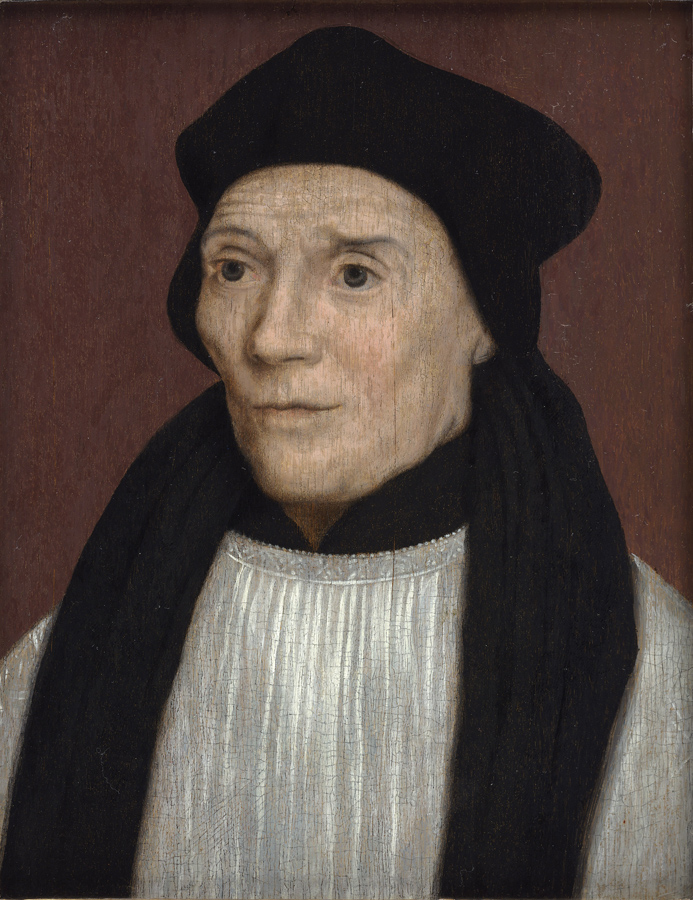
San Juan Fisher
Bishop of Rochester and martyr, beheaded at the Tower of London, 1469-1535
Early life
John Fisher was born at Beverley on 19 October 1469 to a wealthy Yorkshire family.[1] At 14 he entered the University of Cambridge and took a degree in theology; at 22 he was ordained a priest by exception and became confessor and chaplain to Countess Margherita Beaufort, the future grandmother of Henry VIII.[1] Together they founded Saint John's and Christ's College, of which he became vice-chancellor, requiring the study of Latin, Greek or Hebrew, the languages of the Bible; a Latinist, he began studying Greek at 48 and Hebrew at 50.[1]
Ministry
In 1504 he was consecrated Bishop of Rochester, one of the smallest and poorest dioceses in the country, which he never wished to leave and which he called his poor bride.[1] In 1523 he entered the struggle against the Lutheran Reformation as it spread to England, standing beside the king in defence of the primacy of the Church of Rome, and published the De veritate corporis et sanguinis Christi in Eucharistia.[1]
Persecution
His relationship with Henry VIII broke down when the king divorced Catherine of Aragon, whose confessor he was, to marry Anne Boleyn without the Pope's dispensation, and the bishop refused the king's request to go against the Roman Pontiff.[1] Ordered to swear loyalty to the king, he answered: only as far as the law of Christ allows.[1] In 1534 Henry VIII prepared the Act of Supremacy, to which all bishops were to submit; he refused, was arrested on 13 April and imprisoned in the Tower of London, and the see of Rochester was declared vacant.[1] In prison, during the trial in which he was condemned to death, he found an old friend, Thomas More, a lay jurist also condemned for refusing to swear obedience to the king; though not in the same cell, they supported and comforted each other.[1]
Death and recognition
In Rome the Pope decided to create him a cardinal in an attempt to save him, but Henry VIII refused to release him.[1] On 22 June he was woken by the guards and told that his execution was set for ten o'clock that day; on the scaffold he refused loyalty to Henry VIII three more times.[1] Thomas More followed him a few days later, and the Catholic Church keeps the memory of the two saints on the same day.[1] He was beatified on 29 December 1886 by Pope Leo XIII.[1] He was canonised on 19 May 1935 by Pope Pius XI.[1]
Siga la evidencia
Fuentes y notas
- John Fisher
Dicastery for the Causes of Saints · italiano
Consultado el 2026-09-05
Notas editoriales
Translated and condensed from the Dicastery's official Italian profile by an automated pass on 2026-09-09; identity matched on the death date and name; editorial review pending.
Este es un borrador asistido por IA preparado a partir de las fuentes anteriores. Sus citas identifican la evidencia; no sustituyen una revisión histórica.
La biografía heredada
La biografía anterior de este registro.
Leer la biografía heredada
San Juan Fisher, también conocido como Juan de Rochester o Juan Fisher de Rochester, nació en 1469 en Beverly, Yorkshire, Inglaterra. Desde muy joven mostró gran destreza intelectual y posteriormente estudió teología en la Universidad de Cambridge. Obtuvo sus títulos en 1487 y 1491, consolidándose como teólogo erudito. Tras sus estudios, Fisher se convirtió en párroco en Northallerton, Inglaterra, sirviendo desde 1491 hasta 1494. Durante este tiempo ganó fama por sus excepcionales dotes docentes. Su talento fue reconocido por la Iglesia, y fue nombrado Procurador de la Universidad de Cambridge. En 1497, Fisher se convirtió en confesor de Margarita de Beaufort, madre del rey Enrique VII. Esta posición consolidó aún más su posición dentro de la Iglesia. En 1504, fue consagrado obispo de Rochester, Inglaterra.
En su cargo de obispo, trabajó incansablemente por mejorar la predicación en su diócesis y fue conocido por su piedad y compromiso con la educación religiosa. Además de sus responsabilidades eclesiásticas, Fisher ocupó prominentes cargos académicos. Sirvió como Canciller de Cambridge y fue nombrado tutor del joven rey Enrique VIII. Sus excepcionales dotes oratorias y escritas contribuyeron a su elevada posición tanto en la Iglesia como en los círculos académicos. Sin embargo, en 1527, el curso de la vida de Fisher cambió drásticamente. Se le encomendó estudiar la cuestión del matrimonio del rey Enrique VIII y se convirtió en blanco de la ira del rey cuando defendió la validez del matrimonio y rechazó la pretensión de Enrique de ser jefe de la Iglesia en Inglaterra.
Como resultado de su oposición a las acciones de Enrique, Fisher fue encarcelado en 1534 sin juicio. Estuvo cautivo durante 14 meses, manteniéndose firme en sus convicciones y sin vacilar en su fe. Mientras estaba preso, su reputación y dedicación a la fe católica fueron reconocidas por el Papa Pablo III. En 1535, fue creado cardenal en reconocimiento a su vida santa y a su resistencia inquebrantable a los cambios religiosos que ocurrían en Inglaterra. El 22 de junio de 1535, San Juan Fisher fue martirizado. Fue ahorcado, descuartizado y colgado en Tower Hill, Tyburn, Londres, Inglaterra. Su cuerpo fue enterrado en el cementerio de la iglesia de Todos los Santos, Barking, Inglaterra, sin ningún rito religioso ni sudario. Su cabeza fue exhibida en el Puente de Londres durante dos semanas como advertencia a otros, antes de ser arrojada al río Támesis.
Hoy en día, reliquias de San Juan Fisher pueden encontrarse en la Iglesia de San Pedro en la Torre de Londres. Fue beatificado el 29 de diciembre de 1886 por el Papa León XIII y canonizado el 19 de mayo de 1935 por el Papa Pío XI. San Juan Fisher es venerado como defensor valiente de la fe católica. Es el santo patrón de la Diócesis de Rochester, Nueva York, y suele representarse como un cardenal con un hacha cerca, un cardenal con su gorro a sus pies, o un cardenal con rostro envejecido y desgastado. Su vida y martirio sirven de inspiración a todos los que se esfuerzan por permanecer firmes en sus creencias, incluso frente a la persecución.
Wikimedia Commons
También se celebran el 22 de junio
¿Conoces una gracia o milagro atribuido a San Juan Fisher?
Reportar una Gracia o Milagro