SaintPre-Congregation
Saint Cassian of Imola
Saint Cassian of Imola, also known as Cassiano, was a renowned schoolmaster at Imola, Italy during the early 4th century.
Biography
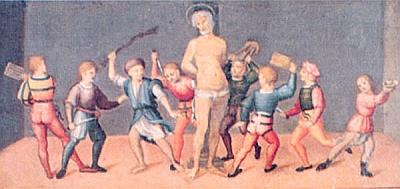
Saint Cassian of Imola, also known as Cassiano, was a renowned schoolmaster at Imola, Italy during the early 4th century. He was known for his expertise in teaching handwriting, but he also took every opportunity to share his faith in Christianity with his students. Cassian's unwavering dedication to his beliefs would eventually lead to his martyrdom. During one of the imperial persecutions of Christians, Cassian was ordered to sacrifice to pagan gods. However, he adamantly refused to renounce his faith. As a result, he was handed over to his pagan students, who were ordered to execute him. In a distressing turn of events, the children whom he once taught reluctantly carried out this gruesome act, stabbing him to death. Saint Cassian is often depicted in art as a man being stabbed by children, symbolizing his martyrdom at the hands of his own students.
Other representations of him include objects associated with his profession as a schoolmaster, such as paper, a pen, and writing instruments. Cassian died on August 13, around the year 304, in Imola, Italy. His death was a result of being tied to a post, tortured, and stabbed to death with iron styles, which were commonly used as pencils on wax tablets. He was buried in the catacombs of Rome, but later a sepulchre was built over his place of burial in the 4th century. In the 5th century, a basilica was constructed in place of the sepulchre. In 1175, Cassian's relics were transferred from Rome and enshrined in the crypt of the cathedral in Imola, where they remain to this day.
Around 1405, the relics were housed in a silver and copper reliquary. From 1577 to 1914, a yearly procession was held in Imola to honor the saint and his relics. In 1684, some relics, including four pieces of the post to which he was tied during his martyrdom, were transferred to Bressanone, Italy. Saint Cassian of Imola was canonized as a saint before the formal process of canonization existed, hence his status as a Pre-Congregation saint. He is recognized as the patron saint of parish clerks, secretaries, stenographers, students, and teachers. Additionally, he is honored in the dioceses of Bolzano-Bressanone and Brixen in Italy. Devotion to Saint Cassian extends beyond Italy. He is also venerated in various locations around the world, including Bibbiena, Cassano Valcuvia, Comacchio, Laterina, Macherio, Rogeno, San Casciano dei Bagni, San Casciano in Val di Pesa, San Cassiano a Vico, San Cassiano di Controne, San Cassiano di Moriano, and Trecate in Italy.
Outside of Italy, he is revered in Mexico City, Mexico, and Las Galletas, Tenerife, Spain. Saint Cassian of Imola serves as an inspiration for his unwavering commitment to his faith, even in the face of persecution and betrayal by those he taught. His courage and martyrdom continue to be celebrated and remembered by the faithful, especially those involved in education and clerical professions.
Also remembered on August 13
Know of a grace or miracle attributed to Saint Cassian of Imola?
Report a Grace or Miracle