SaintMartyrPre-Congregation
Saint James the Greater
Saint James the Greater, also known as Iago, Jacobus de Oudere, Jacobus Major, Jakobus der Ältere, James Major, James the Elder, James the More, James the son of Zebedee, James, son of Zebedee, Santiago, Santiago de…
Biography
Saint James the Greater, also known as Iago, Jacobus de Oudere, Jacobus Major, Jakobus der Ältere, James Major, James the Elder, James the More, James the son of Zebedee, James, son of Zebedee, Santiago, Santiago de España, Santiago de los Caballeros, and Son of Thunder, was one of the twelve Apostles chosen by Jesus Christ. He was the son of Zebedee and Salome, and the brother of Saint John the Apostle. James was known as "the Greater" because he became an Apostle before Saint James the Lesser. It is believed that he may have been Jesus' cousin. He was a fisherman by trade and was called by Jesus to follow Him as a fisher of men. James left everything behind, including his livelihood, to become one of Jesus' closest disciples.
Saint James was present during most of the recorded miracles of Christ and witnessed key events such as the Transfiguration and the Agony in the Garden. He was also present at the Last Supper and in the Garden of Gethsemane. After Jesus' death and resurrection, James played a significant role in spreading the message of Christianity. He preached in various regions, including Samaria, Judea, and Spain. He is considered the first Apostle to have preached outside of the Holy Land. Saint James the Greater met a martyr's death. According to tradition, he was the first of the Apostles to be martyred. In the year 44, King Herod Agrippa I ordered his execution. James was stabbed with a sword in Jerusalem.
Legend has it that his body was taken by angels and transported in a rudderless and unattended boat to Spain, where a massive rock closed around it. His relics were enshrined at the church of Saint James in Compostela, Spain. The pilgrimage to Saint James' relics in Compostela gained immense popularity and became a significant devotion. As a result, he became the patron saint of pilgrims. The symbols of pilgrims, such as the scallop shell and pilgrim's staff, are often associated with Saint James the Greater. His association with Spain and the housing of his relics there led to his patronage of the country and all things Spanish. For centuries, Spanish armies would ride to battle with the cry "Santiago!"
(meaning "Saint James!"). Numerous stories and legends have developed around Saint James the Greater. One popular legend tells of him bringing back to life a boy who had been unjustly hanged and dead for five weeks. The boy's father initially dismissed the story as nonsense, claiming his son was no more alive than the roasted fowl on the table. However, the cooked bird promptly sat up, sprouted feathers, and flew away, signifying the miracle performed by Saint James. Iconographic representations of Saint James the Greater often depict him holding various symbols such as a key, pilgrim's hat, staff, sword, cloak, or a cockle shell. These symbols represent his pilgrimage, patronage of pilgrims, and his role as the patron saint of Spain.
Saint James the Greater is venerated as a pre-congregation saint, meaning his cult developed before the formal canonization process was established. His feast day is celebrated on July 25th, though it was formerly observed on August 5th. Other feast days associated with him include December 30th (translation of relics), January 3rd (translation of relics to the monastery of Saint Vaast), April 30th (Orthodox), December 29th (Armenian), April 12th (Coptic), December 27th (Syrian Orthodox). Saint James the Greater is the patron saint against arthritis, rheumatism, and for arthritis and rheumatoid sufferers. He is also the patron of apothecaries, blacksmiths, druggists, equestrians, furriers, hat makers, horsemen, knights, laborers, pharmacists, riders, soldiers, Spanish conquistadors, tanners, veterinarians, and the Army of Portugal. He is the patron saint of various places, including Bangued diocese in the Philippines, Caltagirone diocese in Italy, Seattle archdiocese in Washington, Kapellen in Belgium, Hettstedt and Rhinow in Germany, Antigua in Guatemala, Medjugorje in Bosnia-Herzegovina, and Montreal in Canada.
Saint James the Greater is widely revered and continues to inspire believers around the world with his story of faith, discipleship, and devotion to spreading the Gospel message.
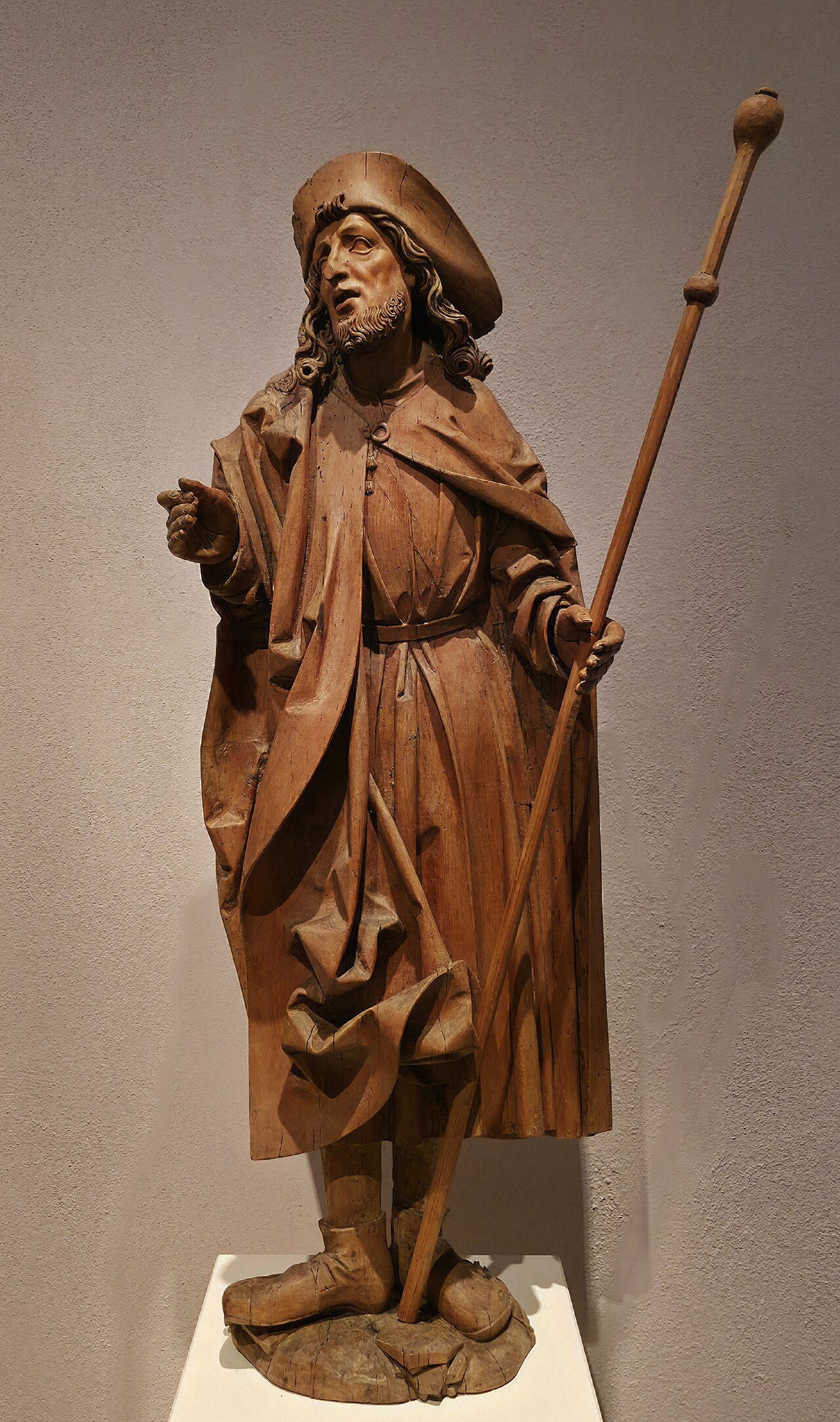
Wikimedia Commons
Also remembered on July 25
Know of a grace or miracle attributed to Saint James the Greater?
Report a Grace or Miracle