SaintPre-Congregation
Saint Nonnosus of Monte Soratte
Saint Nonnosus of Monte Soratte, also known as Nonossus or Nonnoso, was a Benedictine monk and later the prior and abbot of the San Silvestre monastery on Monte Soratte, north of Rome, Italy.
Biography
Saint Nonnosus of Monte Soratte, also known as Nonossus or Nonnoso, was a Benedictine monk and later the prior and abbot of the San Silvestre monastery on Monte Soratte, north of Rome, Italy. He was born around 500 and died around 575 of natural causes. His feast day is celebrated on September 2nd. Nonnosus is known to have suffered great abuse and harassment from his abbot, but despite this, he was the only person who could calm the man down and reason with him. His abilities to pacify and counsel his troubled abbot earned him great respect and admiration among his fellow monks. In addition to his skills in dealing with difficult situations, Nonnosus was also known for his many miracles.
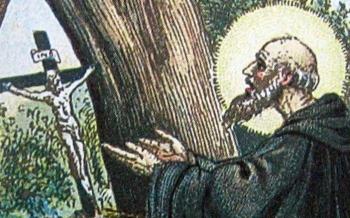
Legends have been passed down regarding some of his most famous miracles, which are now associated with his representation and veneration. One such miracle involves an oil lamp. It is said that Nonnosus
prayed over a broken oil lamp, and it was miraculously reconstructed, as good as new. This miracle demonstrated Nonnosus' faith and the power of his prayers. Another miracle attributed to him involves a large rock or stone in the monastery's garden. It is said that teams of oxen were unable to remove the stone, preventing the cultivation of the land. Nonnosus, desiring to plant cabbages on the land, prayed fervently and was able to move the stone by himself. This miracle demonstrated Nonnosus' faith in God's power to overcome obstacles.
Yet another miracle is associated with jars of olive oil. After a failed olive harvest, Nonnosus filled all the olive oil jars by praying over them. Through his intercession, the jars were filled with an abundance of oil, surpassing what was originally expected. This miracle showcased Nonnosus' belief in the providence of God and his ability to provide for his people. Pope Saint Gregory the Great, known for his writings on various saints, also wrote about Nonnosus. This papal affirmation further solidified Nonnosus' reputation as a holy man worthy of veneration. Following his death, Nonnosus was buried on Monte Soratte in the Viterbo area of Italy. However, in the 9th century, his relics were transferred to Castel Sant'Elia to prevent destruction by invading Muslims.
These relics became the focal point for pilgrimages and were later enshrined in Freising, Germany, around 1050, by Bishop Nitker. The relics were re-buried in a stone coffin in 1161, which was raised off the floor of the cathedral crypt in Freising. Over time, a tradition developed whereby people would crawl around or under the coffin lengthwise, seeking the intercession of Nonnosus, particularly for kidney problems. This unique tradition has persisted to this day. The oil from the eternally burning grave lamp, located near Nonnosus' relics, is reputed to possess healing powers. In the mid-17th century, some of his relics were taken to Bamberg, Germany. Additionally, his head was known to have been enshrined separately by 1660. Today, Saint Nonnosus of Monte Soratte is venerated as a patron against infirmities or weakness, particularly kidney ailments. He is also considered a patron of the Diocese of Nepi-Sutri in Italy, Castel Sant'Elia, and Freising in Germany. His life and the miracles attributed to him continue to inspire believers to have faith in God's power and seek his intercession.
Also remembered on September 2
Know of a grace or miracle attributed to Saint Nonnosus of Monte Soratte?
Report a Grace or Miracle