SaintPre-Congregation
Saint Werenfridus
Saint Werenfridus, also known as Wer(e)nfred, was an 8th-century Benedictine monk hailing from Northumbria, England.
Biography
Saint Werenfridus, also known as Wer(e)nfred, was an 8th-century Benedictine monk hailing from Northumbria, England. As a devoted follower of Christ, he pursued a life of solitude and study as a hermit in Ireland. However, he was called to fulfill a higher purpose and became a missionary priest to the Frisian people in what is now modern-day Netherlands, as well as parts of northern France.
Saint Werenfridus dedicated himself not only to preaching and teaching the Word of God but also to embodying a life of prayer, piety, and charity. He exemplified his faith through his unwavering commitment to helping the poor and providing solace to those who were suffering. During his mission, he collaborated closely with other revered figures of his time, such as Saint Willibrord of Echternach and Saint Swithbert.
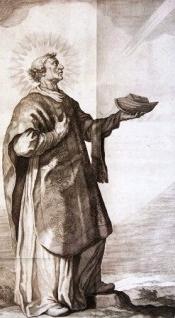
In artwork and icons, Saint Werenfridus is often depicted as a priest holding a boat containing a coffin, symbolizing his unique role as a missionary priest. Other representations show him vested for Mass while holding a ship with a coffin inside, or as a dead priest laid in a ship. This imagery serves as a reminder of his important mission and the ultimate sacrifice he made for the spread of Christianity.
Saint Werenfridus is recognized as the patron saint against arthritis pain, gout, and stiff joints. Additionally, he is revered as a patron of gardeners in the Netherlands. His feast days are celebrated on August 14th in Elst, Netherlands, and on August 27th in Emmerich, Netherlands. Some calendars also commemorate him on November 8th and August 28th.
The saint passed away around 780 in Westeroort, Netherlands, due to natural causes. According to legend, his coffin was pushed onto the waters of the river Rhine, and he was laid to rest where it ultimately came ashore, in Elst, Netherlands. This incident remains a significant part of local history and is commemorated on the Overbetuwe province coat of arms. Throughout the years, a series of churches have been built on his grave site, with the most recent one constructed in 1875. The tomb of Saint Werenfridus has become a site of pilgrimage and healing, particularly for those suffering from gout.
Sadly, the saint's relics were largely destroyed by Protestants in 1588. However, in 1664, the remaining relics were re-enshrined in the Jesuit church in Emmerich, Germany, where they are venerated to this day. Although he has yet to be officially canonized by the Catholic Church, Bishop Baldric of Utrecht, Netherlands, included Saint Werenfridus in the litanies of the diocese in the 10th century, acknowledging his revered status.
Know of a grace or miracle attributed to Saint Werenfridus?
Report a Grace or Miracle