Blessed
Blessed Franz Jägerstätter
Farmer, husband and father, martyr, St Radegund, Upper Austria, 1907-1943
Early life
Franz Jägerstätter was born on 20 May 1907 in St Radegund, Upper Austria, to his unmarried mother, Rosalia Huber, and to Franz Bachmeier, who was killed during World War I.[1] After the death of his natural father, Rosalia married Heinrich Jägerstätter, who adopted the boy and gave him his surname in 1917.[1] He received a basic education in the village's one-room schoolhouse, his step-grandfather helped with his education, and he became an avid reader.[1] In his younger years he was, it seems, unruly, and was the first in his village to own a motorcycle.[1]
Faith and family
After his marriage to Franziska in 1936 and their honeymoon in Rome, he grew in his faith.[1] Besides his farm work he became the local sexton in 1936 and began receiving the Eucharist daily, refusing the customary offering for his services at funerals.[1] In 1938 he was the only local citizen to vote against the 'Anschluss', the annexation of Austria by Germany, though he was neither a revolutionary nor part of any resistance movement.[1] He was called up for military service and sworn in on 17 June 1940, was allowed to return to the farm thanks to the intervention of his mayor, and was later in active service from October 1940 to April 1941.[1] He became convinced that participation in the war was a serious sin and decided that any future call-up had to be met with his refusal to fight.[1]
Martyrdom and recognition
In February 1943 he was called up again; he presented himself at the induction centre on 1 March 1943, announced his refusal to fight and offered to carry out non-violent services, which was denied him.[1] He was held in custody at Linz in March and April, transferred to Berlin-Tegel in May, and tried on 6 July 1943, when he was condemned to death for sedition.[1] On 9 August, before being executed, he wrote that neither prison nor chains nor sentence of death could rob a man of the Faith and his free will.[1] He was beatified by Pope Benedict XVI on 26 October 2007.[1]
Follow the evidence
Sources and notes
- Franz Jägerstätter
Dicastery for the Causes of Saints · Italian
Accessed 2026-09-05
Editorial notes
Translated and condensed from the Dicastery's official Italian profile by an automated pass on 2026-09-09; identity matched on the death date and name; editorial review pending.
This is an AI-assisted draft prepared from the sources above. Its citations identify its evidence; they do not replace a historical review.
The inherited biography
The earlier biography for this record.
Read the inherited biography
Blessed Franz Jágerstátter, also known as Franz Jaegerstaetter, was born on May 20, 1907 in Sankt Radegund, Oberösterreich, Austria. He was born to Rosalia Huber and Franz Bachmeier, who were both servants and too poor to get married. Tragically, Franz's father died in World War I when Franz was just a young boy. Following his father's death, his mother married local farmer Heinrich Jágerstátter, who adopted Franz and raised him as his own.
Although Franz had limited formal education, his adoptive father Heinrich was committed to ensuring that he could read and educate himself. Franz worked in the iron ore industry for three years from the age of 20. During his early 20s, he led a rather reckless and dissolute life. However, in his late 20s, he decided to settle down and embraced a life as a peasant farmer. At this time, Franz also became deeply committed to his faith, married, and became the loving father of three daughters.
Franz served as the sacristan for his parish, taking care of funeral and prayer services. He wholeheartedly dedicated himself to his faith, attending Mass daily and developing a special ministry to support the bereaved. Franz became well-known for his vocal criticism of the Nazis, standing out as the only person in his village who voted against Austrian unification with Germany in 1938. In response to the ubiquitous Nazi greeting "Heil Hitler," Franz famously countered with "Pfui Hitler." Due to his unwavering beliefs, Franz experienced social isolation within his own community.
When drafted into the army of the Third Reich, Franz encountered a profound conflict between his military service and his faith. After initially serving briefly behind the lines, he made the courageous decision to refuse further military service. As a result, he was arrested and imprisoned in both Linz, Austria, and Berlin, Germany. He underwent a military trial and was ultimately executed by beheading in Brandenburg an der Havel on August 9, 1943.
During his time in prison, Franz turned to prayer, supported fellow prisoners, and composed a series of heartfelt letters and essays. Despite the risks, he remained steadfast in his belief that it was incompatible with his faith to serve in the Nazi army. His moral courage and unwavering commitment to his principles marked him as a true martyr.
Recognizing his martyrdom, Pope Benedict XVI declared Franz Jágerstátter venerable on June 1, 2007. Later that same year, on October 26, 2007, Pope Benedict XVI beatified Franz, bestowing upon him the title of Blessed Franz Jágerstátter.
Today, Franz Jágerstátter stands as a shining example of unwavering faith, moral integrity, and steadfast resistance in the face of injustice. His life and sacrifice continue to inspire and challenge people to stand against evil and remain faithful to their beliefs, even in the most challenging circumstances.
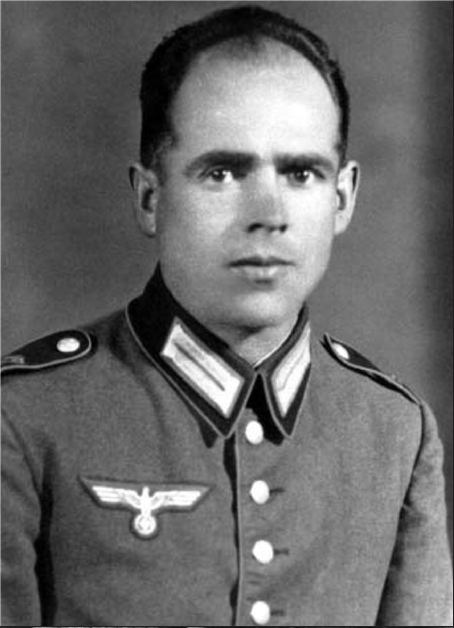
Image: Public domain via Wikimedia Commons (Franz Jägerstätter in a Wehrmacht uniform (ID photo).png)
Know of a grace or miracle attributed to Blessed Franz Jägerstätter?
Report a Grace or Miracle