SantoAnterior a la Congregación
San Agustín de Hipona
A North African teacher, convert, and bishop whose searching account of the self became inseparable from the responsibilities and conflicts of his Church.
Growing up in Roman Africa
Augustine was born on 13 November 354 at Thagaste in Roman North Africa, the son of Patricius and Monica.[1] The town is now Souk Ahras in Algeria; Monica raised him within Christianity, but his baptism was deferred while his parents pursued opportunities for his education.[2] His studies took him from Thagaste to Madaura and then to Carthage, where rhetoric offered a path toward professional distinction.[1] He had a long relationship with a woman whose name his Confessions does not give; recalling their eventual separation, he describes deep attachment and grief.[3] Their son, Adeodatus, became a participant in his father’s intellectual life and the dialogue On the Teacher, before dying young.[4]
The search for wisdom
Reading Cicero’s Hortensius awakened Augustine’s desire for wisdom, while the biblical texts initially disappointed his literary expectations and raised questions he could not resolve.[1] He joined the Manichaeans, whose account of opposed principles of good and evil initially appealed to him, but eventually found their answers inadequate.[1] His work as a teacher carried him from Africa to Rome and Milan, a professional journey accompanied by a prolonged religious search.[2] Platonic philosophy helped him conceive of spiritual reality, while the letters of Paul increasingly directed him toward a God encountered through Christ.[5]
Milan and the decision to change
In Milan, Bishop Ambrose’s preaching showed him ways of reading the Old Testament that answered objections he had once considered decisive.[1] In the Confessions, Augustine portrays his difficulty as a divided will: he could recognize a life he desired while remaining attached to habits he feared surrendering.[6] According to his own account, while weeping in a garden he heard a child’s voice urging him to read and took it as a divine summons.[6] He opened Paul’s letter to the Romans at its call to abandon disordered living and put on Christ, then shared his new resolve with Alypius and Monica.[6] Benedict XVI interprets this turning point as the beginning of a continuing conversion, whose demands extended through Augustine’s later ministry.[5]
Baptism, bereavement, and community
Ambrose baptized Augustine at the Easter Vigil of 387 in Milan.[5] Alypius and Adeodatus were baptized with him; Augustine remembers the Church’s hymns moving him to tears as he entered this new life.[4] While awaiting passage to Africa at Ostia, he and Monica spoke about eternal life; soon afterward she developed a fever and died.[4] His account preserves her request to be remembered at the altar wherever her family might be, relinquishing her earlier desire for burial beside her husband.[4] Back in Thagaste, Augustine established a shared life of prayer, work, and study with companions, hoping to devote himself to Christian contemplation.[2]
A bishop among his people
A visit to Hippo in 391 changed those plans: he was called to priestly ministry, assisted Bishop Valerius, and established another monastic community.[2] After becoming a bishop, Augustine succeeded Valerius around 396, taking responsibility for pastoral, administrative, and judicial work as well as preaching.[7] Benedict XVI describes this acceptance of public service as another conversion, requiring Augustine to make his learning available to ordinary hearers.[5] He maintained community life in his episcopal household and repeatedly travelled to councils, participating in the wider government of the African churches.[2]
Books written from a life of faith
Written after he became a bishop, the thirteen books of the Confessions combine recollection, acknowledgment of wrongdoing, and praise addressed to God.[8] The City of God responds to questions sharpened by the sack of Rome in 410, examining political life, providence, and the conflicting loves that shape human communities.[8] On the Trinity explores the central Christian confession of one God in three persons, while On Christian Teaching addresses the interpretation and communication of Scripture.[8] His output also includes letters, biblical exposition, catechetical instruction, and sermons recorded by hearers, allowing his pastoral voice to circulate far beyond Hippo.[8] Near the end of his life he reviewed his earlier writings in the Revisions, identifying positions that required correction or clarification.[8]
Grace, freedom, and controversy
Against Pelagius and his followers, Augustine argued that human beings depend radically on divine grace, including in the beginnings of faith and the movement toward a good life.[7] The argument became bitter: Julian of Aeclanum challenged his treatment of freedom and sin, while Augustine believed his opponents diminished the need for Christ’s saving work.[7] These debates shaped later Western discussions of original sin, freedom, and salvation; Augustine’s conclusions have continued to attract both committed defenders and strong critics.[7]
The troubling defense of coercion
In his letter to Vincentius, Augustine acknowledges that he had originally opposed coercing people into Catholic unity, fearing that force would produce only pretended belief.[9] He then defends imperial pressure against the Donatists, arguing that fear of penalties could lead people to reconsider their convictions and eventually accept what he regarded as truth.[9] The letter makes his change of position explicit: his defense of religious unity included support for coercive law, as well as persuasion and theological argument.[9]
The siege of Hippo and his final days
In 426 Augustine presented the priest Heraclius as his intended successor, seeking more time for the study of Scripture in his remaining years.[10] The Vandal invasion brought war to his city, and Hippo came under siege in 430.[10] Amid the danger, he urged clergy not to abandon people who depended on them, insisting that ministers share their communities’ vulnerability.[10] According to his friend and biographer Possidius, Augustine’s final fever was accompanied by prayer over penitential psalms displayed where he could read them.[10] He died on 28 August 430; his remains were later moved to Sardinia and then to Pavia, where the Basilica of San Pietro in Ciel d’Oro became their resting place.[10]
An inheritance that remains open to examination
Benedict XVI finds an enduring example in Augustine’s willingness to recognize his need for forgiveness and revisit his own understanding.[5] Possidius remembers his concern that the church library and his writings be preserved, leaving later readers the means to encounter his teaching for themselves.[8]
Siga la evidencia
Fuentes y notas
- Saint Augustine of Hippo (1)
Holy See · Benedict XVI · 2008-01-09 · inglés
Consultado el 2026-09-05
- Life of Saint Augustine of Hippo
Order of Saint Augustine · inglés
Consultado el 2026-09-05
- Augustine, Confessions, book VI
New Advent · Nicene and Post-Nicene Fathers, first series, vol. 1 · inglés
Consultado el 2026-09-05
- Augustine, Confessions, book IX
New Advent · Nicene and Post-Nicene Fathers, first series, vol. 1 · inglés
Consultado el 2026-09-05
- Saint Augustine of Hippo (5)
Holy See · Benedict XVI · 2008-02-27 · inglés
Consultado el 2026-09-05
- Augustine, Confessions, book VIII
New Advent · Nicene and Post-Nicene Fathers, first series, vol. 1 · inglés
Consultado el 2026-09-05
- Augustine of Hippo
Stanford Encyclopedia of Philosophy · Christian Tornau · 2024-04-26 · inglés
Consultado el 2026-09-05
- Saint Augustine of Hippo (4)
Holy See · Benedict XVI · 2008-02-20 · inglés
Consultado el 2026-09-05
- Augustine, Letter 93 to Vincentius (408)
New Advent · Nicene and Post-Nicene Fathers, first series, vol. 1 · inglés
Consultado el 2026-09-05
- Saint Augustine of Hippo (2)
Holy See · Benedict XVI · 2008-01-16 · inglés
Consultado el 2026-09-05
Notas editoriales
The bishopric involves two events: consecration as a bishop, given as 395 by Benedict XVI, and succession to Valerius, placed around 396 by the Stanford Encyclopedia. The narrative distinguishes them instead of forcing a single precise date.
The Order of Saint Augustine page says Augustine was 33 at baptism and that Hippo was being sacked when he died. The dated Vatican chronology implies age 32 at the Easter Vigil of 387 and describes an ongoing siege in August 430. The draft uses the event dates and siege account, without reproducing those inconsistencies.
The Confessions is retrospective theological autobiography. The garden voice and the interpretation of conversion are attributed to Augustine’s account; no exact calendar day is assigned to the garden episode.
Monica’s death is not assigned a calendar year here: the Stanford entry gives 388, while other chronologies place it in 387. The sequence at Ostia follows Confessions IX.
The surviving account does not name Augustine’s long-term companion. His own emotional description is retained without inventing her biography or motives.
Letter 93 is cited directly for Augustine’s defense of coercion. Reporting his reasoning does not establish the truth of his allegations against religious opponents.
This is an AI-assisted source-based draft. No independent human historical review or publication approval is recorded.
Este es un borrador asistido por IA preparado a partir de las fuentes anteriores. Sus citas identifican la evidencia; no sustituyen una revisión histórica.
La biografía heredada
La biografía anterior de este registro.
Leer la biografía heredada
San Agustín de Hipona, también conocido como Aurelio Agustín, fue un renombrado teólogo católico, filósofo y Doctor de la Iglesia. Nació el 13 de noviembre de 354 en Tagaste, Numidia, que actualmente corresponde a Souk-Ahras, Argelia. Sus padres fueron Santa Mónica, devota cristiana, y su padre pagano, Patricio. Creciendo, Agustín fue educado como cristiano, pero perdió su fe durante su juventud y llevó una vida moralmente desviada. Desde los quince hasta los treinta años, vivió con una mujer cartaginesa y tuvo un hijo llamado Adeodato. Sin embargo, a pesar de este período turbulento, San Agustín continuamente buscó la verdad y la sabiduría. En su madurez, Agustín enseñó retórica en Cartago, donde se expuso a diversas filosofías. Se sintió atraído por el maniqueísmo, una secta religiosa que enfatizaba la lucha entre el bien y el mal y abogaba por un código moral laxo.
Agustín abrazó esta filosofía durante varios años, incluso asumiéndola en sus Confesiones, donde escribió famosamente: «Señor, danos castidad y continencia, pero no ahora». Finalmente, mediante las oraciones de su devota madre y la guía de San Ambrosio de Milán, Agustín experimentó una profunda conversión. Bajo la influencia de Ambrosio, renunció al maniqueísmo y fue bautizado, marcando un punto de giro transformador en su vida. Después de la muerte de su madre, Agustín regresó a África, vendió sus posesiones y entregó el dinero a los pobres. Buscando una vida de santidad, fundó un monasterio en Hipona, Norte de África. Se convirtió en monje, sacerdote y predicador. En el año 396, fue nombrado obispo de Hipona. A lo largo de su vida, Agustín combatió activamente diversas herejías, incluido el maniqueísmo, el donatismo y el pelagianismo.
Durante un período turbulento del Imperio Romano, en declive debido a la invasión de los vándalos, Agustín atendió a su iglesia y su sede, brindando cuidado pastoral y guía a su comunidad. A pesar de los desafíos de aquel tiempo, permaneció firme en su fe y continuó apoyando y nutriendo las comunidades religiosas. Las contribuciones intelectuales y teológicas de San Agustín influyeron profundamente en el pensamiento cristiano. Sus numerosas obras abordaron temas teológicos importantes, como la gracia, el pecado original y la naturaleza de Dios. Sus escritos, como «Confesiones» y «La ciudad de Dios», se han convertido en textos fundamentales de la literatura y filosofía cristianas. El camino espiritual de Agustín puede resumirse en una frase de sus escritos: «Nuestros corazones están hechos para Ti, Señor, y no hallan reposo hasta que descansan en Ti».
Su profundo anhelo por Dios y su búsqueda constante de la verdad resonaron con muchos creyentes a lo largo de los años. San Agustín de Hipona falleció el 28 de agosto de 430 en Hipona, Norte de África. Su canonización tuvo lugar antes de que se estableciera el proceso formal de canonización. Es venerado como santo en la Iglesia Católica y ostenta el título de Doctor de la Iglesia. Su fiesta se celebra el 28 de agosto, mientras que otras fechas significativas incluyen el 5 de mayo (su conversión) y el 24 de abril (celebrado por los agustinos). San Agustín es reverenciado como santo patrón contra los ojos doloridos y los parásitos. Además, es patrón de los cerveceros, impresores, teólogos y varias diócesis, incluidas Bridgeport (Connecticut), Coimbra (Portugal), Ida (Filipinas), Kalamazoo (Míchigan), Laredo (Texas), Leiria–Fátima (Portugal), Portalegre-Castelo Branco (Portugal), San Agustín (Florida), Superior (Wisconsin) y Tucson (Arizona).
También es honrado en diversas ciudades y regiones, como Cagayan de Oro (Filipinas), Carpineto Romano (Italia), Isleta Indian Pueblo, Ponte Nizza (Italia), Riccia (Italia), San Austin (Ibiza, España) y Valletta (Malta). La vida y enseñanzas de San Agustín continúan inspirando y ofreciendo guía espiritual a incontables individuos que buscan a Dios y una comprensión más profunda de la fe cristiana.
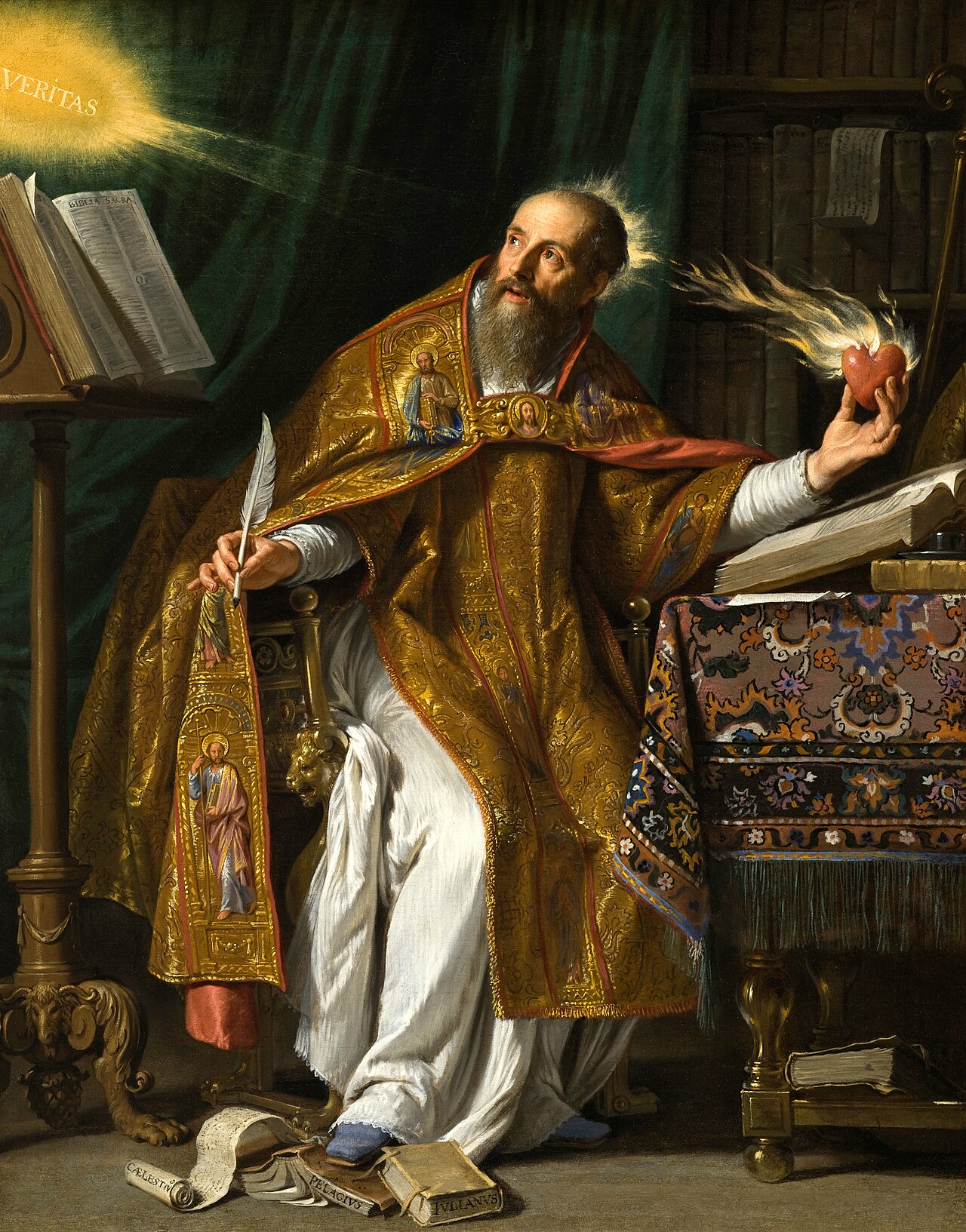
Wikimedia Commons
También se celebran el 28 de agosto

¿Conoces una gracia o milagro atribuido a San Agustín de Hipona?
Reportar una Gracia o Milagro