Santo
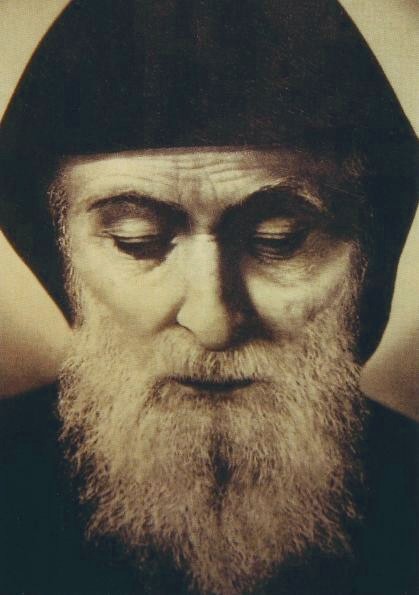
San Charbel Makhlouf
The Maronite monk of Annaya whose hidden life of prayer became the centre of a worldwide devotion.
A vocation in the Lebanese mountains
Charbel was born Youssef Antoun Makhlouf on 8 May 1828 in Bkaakafra, a mountain village in northern Lebanon.[1] His family’s farming life, liturgical prayer, and devotion to Mary formed the setting of his childhood.[2] The example of relatives devoted to the eremitic life helped make monastic service a concrete possibility for him.[2] Paul VI’s beatification address recalls that he lost a parent early in life and eventually left his family to enter the monasteries of Mayfouq and Annaya.[3] The monastery’s biography remembers the young Youssef withdrawing to a grotto dedicated to Mary for prayer and meditation.[1]
Formation as a monk and priest
He joined the Lebanese Maronite Order in 1851 and took the religious name Charbel, also transliterated Sharbel.[1] In 1853 he professed the monastic commitments of obedience, poverty, and chastity.[1] His formation took him from Mayfouq to Saint Maron at Annaya and to theological studies at Kfifane.[2] Among his teachers was Nimatullah al-Hardini; Charbel was ordained a priest on 23 July 1859.[1] The order’s account of his spirituality emphasizes sustained discipleship: learning from other monks and cultivating virtue through the ordinary demands of religious life.[4]
Sixteen years in community
After ordination, Charbel spent sixteen years in the monastic community at Annaya before moving to the hermitage.[1] His life centred on the celebration of Mass, silent prayer before the Blessed Sacrament, and fidelity to his vows.[3] The Lebanese Maronite Order describes his priesthood through the example of Christ’s service and obedience.[4] Material simplicity and hard manual work were part of the same vocation, lived within the demanding conditions of the mountains.[2] In the order’s interpretation, these disciplines belonged to a gradual surrender of self, sustained by a desire for union with God.[4]
At the hermitage of Saints Peter and Paul
With the permission of his superiors, Charbel entered the hermitage of Saints Peter and Paul on 15 February 1875.[1] The hermitage already belonged to Annaya’s monastic life; Charbel entered an established place of prayer.[5] Its history names other hermits who lived there during his years, including Libaos El Ramaty and Makarios Sawma.[5] His withdrawal therefore belonged to a regulated monastic setting with fellow religious and institutional ties.[5] Paul VI explained his solitude as a way of sustained prayer, participation in Christ’s sacrifice, and intercession for others.[2] The order remembers this final period as twenty-three years of increasingly concentrated contemplation.[4]
Death and the growth of devotion
Charbel died at the hermitage on Christmas Eve, 24 December 1898.[1] According to the monastery’s account, reports of light at his tomb, the condition of his remains, and healings drew increasing numbers of visitors.[1] Church authorities began examining reports of physical and spiritual healing associated with devotion to him.[1] The hermitage’s history describes its gradual transformation into an international shrine as devotion expanded after 1950.[5] According to the order’s account of the canonization miracle, Mariam Assaf Awwad recovered after praying for Charbel’s intercession.[4]
Recognition by the Church
Paul VI beatified Charbel on 5 December 1965, near the close of the Second Vatican Council.[2] The pope presented the recognition as a celebration of Eastern monastic holiness and of communion between the Maronite Church and Rome.[3] He canonized Charbel on 9 October 1977, extending his veneration to the universal Church.[2] At the beatification, Paul VI had stressed that the Church’s visible apostolic work also needs communities devoted to prayer and intercession.[3] His canonization homily likewise treated the hermit’s vocation as a contribution to the Church’s shared life, rather than a pattern every Christian must reproduce.[2]
What his life continues to convey
Paul VI drew from Charbel’s example an invitation to silence, detachment, and prayer, adapted to the responsibilities of each person’s life.[3] The order understands the lasting influence of his hidden life through the Gospel image of a seed whose fruit appears through self-giving.[4] Annaya preserves that history in a particular landscape and community, linking the contemporary place of pilgrimage with the monks who lived and worked there.[5] His remembrance keeps a distinct Maronite expression of Christian holiness visible within the wider Catholic tradition.[3]
Siga la evidencia
Fuentes y notas
- Saint Charbel: Biography
Monastery of Saint Maron, Annaya · inglés
Consultado el 2026-09-05
- Canonisation de l’ermite libanais Charbel Makhlouf
Holy See · Paul VI · 1977-10-09 · francés
Consultado el 2026-09-05
- Beatification of the Maronite monk Charbel Makhlouf
Holy See · Paul VI · 1965-12-05 · francés
Consultado el 2026-09-05
- Saint Charbel: chronology and spirituality
Lebanese Maronite Order · árabe
Consultado el 2026-09-05
- The Hermitage of Saints Peter and Paul
Monastery of Saint Maron, Annaya · inglés
Consultado el 2026-09-05
Notas editoriales
This is the nineteenth-century Maronite monk Youssef Antoun Makhlouf, not the ancient martyr also called Charbel. The separate conflated legacy record remains unresolved.
The shrine biography gives 1 November 1853 for profession; the order’s Arabic chronology displays 1 October 1853. The biography retains the supported year without selecting an unsupported exact day.
The shrine’s English prose incorrectly places beatification on 5 January 1965, although its timeline gives 5 December. Paul VI’s 1977 homily explicitly confirms 5 December 1965. The 1965 Vatican page also contains an inconsistent in-page day label.
The hermitage history records fellow hermits. Descriptions of Charbel’s solitude should not be read as proof that nobody else lived at the site.
Miracle and relic accounts are identified as religious claims of the monastery or order. They are not presented as independently verified medical findings.
French and Arabic sources have been paraphrased into English. This expanded biography is an AI-assisted source-based draft; independent human editorial and translation review has not been recorded.
Este es un borrador asistido por IA preparado a partir de las fuentes anteriores. Sus citas identifican la evidencia; no sustituyen una revisión histórica.
La biografía heredada
La biografía anterior de este registro.
Leer la biografía heredada
San Charbel Makhlouf, también conocido como José Zaroun Makhlouf, nació el 8 de mayo de 1828 en la aldea de Beka-Kafra, Líbano. Hijo de un arriero, fue criado por su tío tras la muerte de su padre. Desde joven, Charbel mostró un profundo sentido de piedad y devoción a Dios. Durante su juventud, el libro favorito de Charbel fue La Imitación de Cristo de Tomás de Kempis, que tuvo una profunda influencia en su camino espiritual. A pesar de la oposición de su tío, Charbel sintió una fuerte llamada a la vida religiosa y, a los 23 años, abandonó en secreto su hogar para ingresar al monasterio baladita de San Marón en Annaya. Al ingresar al monasterio, Charbel tomó el nombre de Charbel en honor de un mártir del siglo II.
En 1853, profesó sus votos solemnes, comprometiendo su vida al servicio de Dios. La dedicación de Charbel a su vocación lo llevó a ser ordenado sacerdote en 1859, convirtiéndose en un heirmónjico. San Charbel llevó una vida humilde y austera, siempre esforzándose por imitar a los antiguos padres del desierto, que se dedicaron a la oración y la soledad. En 1875, se retiró de la comunidad y se convirtió en ermitaño, viviendo en aislamiento y practicando un ascetismo extremo. Abrazó una vida de pobreza, confiando en lo mínimo necesario para sus necesidades. La santidad y devoción de Charbel a Dios se volvieron ampliamente conocidas, y las personas acudían a él para recibir guía espiritual y bendiciones. Tenía una profunda devoción personal al Santísimo Sacramento y era frecuentemente visto en oración profunda y contemplación.
Se dice que durante estas oraciones, Charbel flotaba en el aire, siendo levantado del suelo en un estado de éxtasis. Un poco antes de su muerte el 24 de diciembre de 1898, San Charbel experimentó un breve período de parálisis, cuya causa permanece desconocida. Sin embargo, este sufrimiento físico no disminuyó su fe ni su devoción. A lo largo de su vida, Charbel mostró un profundo amor por Cristo y una disposición a soportar cualquier dificultad por el bien de su camino espiritual. Después de la muerte de Charbel, se atribuyeron varios milagros post mortem a él. Destacan los períodos de 1927 y 1950 en los que un "sudor" sangriento fluía de su cadáver, un fenómeno que dejó atónitos a los testigos.
Estos milagros consolidaron aún más su reputación de santidad. Hoy en día, la tumba de San Charbel se ha convertido en un destino para peregrinos de Líbano y más allá, independientemente de sus afiliaciones religiosas. Su vida y camino espiritual continúan inspirando y conmoviendo los corazones de muchos, y sigue siendo querido tanto por cristianos como no cristianos. San Charbel Makhlouf fue venerado por el Papa Pablo VI el 15 de julio de 1965, con la declaración de virtudes heroicas. Fue beatificado posteriormente por el Papa Pablo VI el 5 de diciembre de 1965. Finalmente, el 9 de octubre de 1977, San Charbel fue canonizado por el Papa Pablo VI, reconociendo su excepcional santidad y los milagros asociados a su intercesión. Aunque San Charbel no tiene patronatos específicos atribuidos a él, su vida sirve como testimonio del poder de la fe, la devoción y el sacrificio. Su ejemplo continúa inspirando a incontables individuos a buscar una comunión más profunda con Dios y vivir vidas de profundo amor y servicio.
Wikimedia Commons
También se celebran el 24 de julio
¿Conoces una gracia o milagro atribuido a San Charbel Makhlouf?
Reportar una Gracia o Milagro