Santa
Santa Teresa de Ávila
A Carmelite writer and founder who made friendship with Christ the center of a demanding life of prayer, community, and reform.
A reader in a large household
Teresa was born in Ávila, Spain, on 28 March 1515.[1] Her parents were Alonso de Cepeda and Beatriz de Ahumada, and she grew up in a large family where reading and religious devotion had an important place.[2] In her autobiography, she recalls reading saints’ lives with a brother and imagining that they could obtain martyrdom by travelling into Muslim territory.[3] After her mother’s death, she turned to Mary for maternal protection; her later education with the Augustinian nuns at Santa María de las Gracias helped renew her interest in prayer.[4]
The long years at the Incarnation
Teresa entered the Carmelite Monastery of the Incarnation at Ávila on 2 November 1535, beginning the religious life in which she would spend nearly three decades before her first foundation.[5] She made her profession in 1537 and suffered a grave illness soon afterward, followed by lasting physical difficulties.[2] Francisco de Osuna’s Third Spiritual Alphabet introduced her to the prayer of recollection, giving language and direction to her developing interior life.[2] The busy monastery also drew her into frequent social contact with visitors, and she struggled to reconcile these relationships with the concentration she desired for prayer.[2]
A renewed encounter with Christ
In Lent 1554, the sight of an image of the wounded Christ marked a decisive turning point in Teresa’s religious life.[4] She remembers throwing herself before the image in tears, asking for the strength to change and placing greater confidence in God than in herself.[3] Reading Augustine’s Confessions deepened this experience: his account of conversion seemed to speak directly to her own struggle to give herself fully to God.[3]
Prayer, experience, and discernment
Teresa presents mental prayer as a friendship sustained by private conversation with God, encouraging people to persevere even when their conduct and attention remain imperfect.[3] For her, the humanity of Jesus remains central to the spiritual life, giving contemplation its focus in the incarnate Christ.[1] According to her account, she experienced a vision of an angel piercing her heart with a fiery spear, describing spiritual pain joined to an overwhelming love of God.[3] Paul VI emphasizes that she submitted extraordinary experiences to ecclesial discernment and placed faithful obedience above visions, revelations, or ecstasies.[1]
Saint Joseph’s and a new community
Her first new monastery, Saint Joseph’s at Ávila, was established in 1562 with ecclesiastical authorization, amid opposition and practical difficulties in preparing the house.[3] The Discalced Carmelite account places this foundation within her desire to renew her own life and recover the resources of the older Carmelite tradition.[6] The sisters’ common life joined sustained prayer for the Church with affection, mutual charity, and demanding spiritual discipline.[1] The order understands her work as both continuity with Carmel and the creation of a renewed way of living its vocation.[6]
The reform takes to the road
Teresa’s concern broadened from the reform of a community to the needs of the wider Church, including the missionary horizons opened by contact with the Americas.[6] The testimony of the Franciscan Alonso Maldonado, returning from Mexico, helped sharpen her desire to support evangelization through the life of her communities.[5] With John of the Cross and Antonio of Jesus, the reform extended to friars at Duruelo on 28 November 1568.[6] Further foundations spread across Spain, and in 1580 the reformed communities obtained authorization to form a separate province.[4] This work required negotiation over money, permissions, suitable houses, and local opposition, undertaken through difficult journeys despite her poor health.[2]
The writer and her books
Teresa wrote as a woman of Jewish-convert ancestry whose spiritual authority could attract suspicion, knowing that ecclesiastical censors would examine her work.[2] The Book of Her Life recounts her spiritual history, while The Way of Perfection offers the sisters practical instruction in virtues and contemplative prayer.[4] The Interior Castle examines growth in life with God, and The Book of the Foundations recounts the work and difficulties of establishing new communities.[1] Her letters preserve the practical and personal concerns of an active founder, while her spiritual accounts submit experiences of prayer to examination.[1] Benedict XVI presents her teaching as a guide to prayer rooted in Scripture, evangelical virtues, and a living relationship with Christ.[4]
Opposition and persistence
Her autobiography was reported to the Inquisition, but the theologian Domingo Báñez delivered a favorable assessment in 1575; further accusations in Seville also ended without condemnation.[5] The order’s account reads her repeated professions of inadequacy and obedience in light of the pressures facing a woman who wrote about spiritual matters and taught others.[2] The later Discalced tradition remembers her as its mother and foundress, whose example joins fidelity to an inherited vocation with a willingness to renew its expression.[6]
Death and recognition as a teacher
After the foundation at Burgos, Teresa died at Alba de Tormes on 4 October 1582, the last day before Spain’s calendar advanced directly to 15 October.[5] Paul V beatified her in 1614, and Gregory XV canonized her in 1622.[4] On 27 September 1970, Paul VI proclaimed her a Doctor of the Church, the first woman to receive that title.[1] His assessment connects the authority of her teaching with a life in which contemplation strengthened practical service to the Church and the people around her.[1]
Siga la evidencia
Fuentes y notas
- Multiformis sapientia Dei: Teresa proclaimed Doctor of the Church
Holy See · Paul VI · 1970-09-27 · inglés
Consultado el 2026-09-05
- St. Teresa of Jesus: biography, spirituality, and writings
Discalced Carmelites · inglés
Consultado el 2026-09-05
- The Life of St. Teresa of Jesus, written by herself
Project Gutenberg · David Lewis translation, revised and annotated by Benedict Zimmerman, 1904 edition · inglés
Consultado el 2026-09-05
- Saint Teresa of Avila
Holy See · Benedict XVI · 2011-02-02 · inglés
Consultado el 2026-09-05
- 15 October: Saint Teresa of Jesus, Doctor of the Church
Vatican City State · Governorate · inglés
Consultado el 2026-09-05
- History of Discalced Carmelites
Discalced Carmelites · inglés
Consultado el 2026-09-05
Notas editoriales
Death is recorded as 4 October 1582 in the Julian calendar, following the 1970 apostolic letter and the Vatican City State account. Spain’s next civil day was 15 October after the Gregorian reform. The 2011 audience’s reference to the night of 15 October must be read against that calendar transition, not treated as eleven additional days of life.
The English Discalced Carmelite history contains an impossible date of 1599 for a vision, after Teresa’s death. That date is not used. Its date for the superior general’s visit also differs from the Governorate’s account; the biography does not assign a year to that visit.
The autobiography’s paragraph numbering in the David Lewis–Benedict Zimmerman edition differs from numbers used in modern papal citations. Locators here explicitly identify the edition: the friendship passage is VIII.7 and the piercing-heart vision XXIX.16–17.
Teresa’s own recollection of her age at her mother’s death differs from the order’s chronology. This draft preserves the bereavement without imposing an exact age or year.
Descriptions of mystical experiences are attributed to Teresa’s testimony. No retrospective medical diagnosis or independent verification of a supernatural event is claimed.
Source descriptions of travel distances and foundation totals are not harmonized into an invented precise total; the narrative follows the documented foundations and institutional developments.
This is an AI-assisted source-based draft. No independent human historical review or publication approval is recorded.
Este es un borrador asistido por IA preparado a partir de las fuentes anteriores. Sus citas identifican la evidencia; no sustituyen una revisión histórica.
La biografía heredada
La biografía anterior de este registro.
Leer la biografía heredada
Santa Teresa de Ávila, también conocida como Teresa de Ávila, Teresa de Jesús y Teresa Sánchez Cepeda Davila y Ahumada, nació el 28 de marzo de 1515 en Ávila, Castilla, España. Nació en una familia noble, hija de don Alonso Sánchez de Cepeda y doña Beatriz. Desde pequeña, Teresa quedó fascinada por las vidas de los santos y solía jugar a ser "eremita" en el jardín. Durante su juventud, Teresa contrajo una grave enfermedad que la dejó coja. Fue durante este tiempo cuando recibió su educación en casa, lo que nutrió aún más su amor por la lectura y el crecimiento espiritual. Por su devoción y oración a San José, Teresa fue milagrosamente curada de su afección. Tristemente, la tragedia golpeó cuando su madre falleció cuando ella tenía apenas 12 años.
Tras esta pérdida, Teresa se volvió hacia Nuestra Señora y le pidió su intercesión, orando por una madre espiritual que la guiara. Con su padre en contra de su deseo de entrar en vida religiosa, Teresa tomó una decisión audaz. A los 17 años, abandonó su hogar sin informar a nadie y entró en una casa carmelita. La firme convicción y dedicación de Teresa a su llamado acabaron por convencer a su padre y familia para que aceptaran su vocación religiosa. Poco después de tomar sus votos como monja carmelita, Teresa cayó gravemente enferma. Desafortunadamente, la ayuda médica que recibió fue insuficiente, lo que provocó una progresiva deterioro en su salud. Fue durante este tiempo cuando comenzó a experimentar visiones místicas.
Reconociendo el profundo impacto de estas visiones, Teresa fue examinada por figuras influyentes como dominicos y jesuitas, incluido San Francisco de Borja. Tras una minuciosa revisión, se determinó que las visiones de Teresa eran auténticas, santas y verdaderas. Al considerar que su convento original era demasiado permisivo en el cumplimiento de la regla carmelita, Teresa emprendió una misión para reformar la orden. En 1562, fundó el primer convento reformado de San Juan de Ávila. A pesar de enfrentar una firme oposición por parte de las autoridades locales, la determinación inquebrantable de Teresa le permitió establecer varios conventos más reformados de carmelitas. Las profundas intuiciones espirituales y experiencias de Santa Teresa de Ávila inspiraron su extensa escritura sobre sus encuentros místicos con Dios.
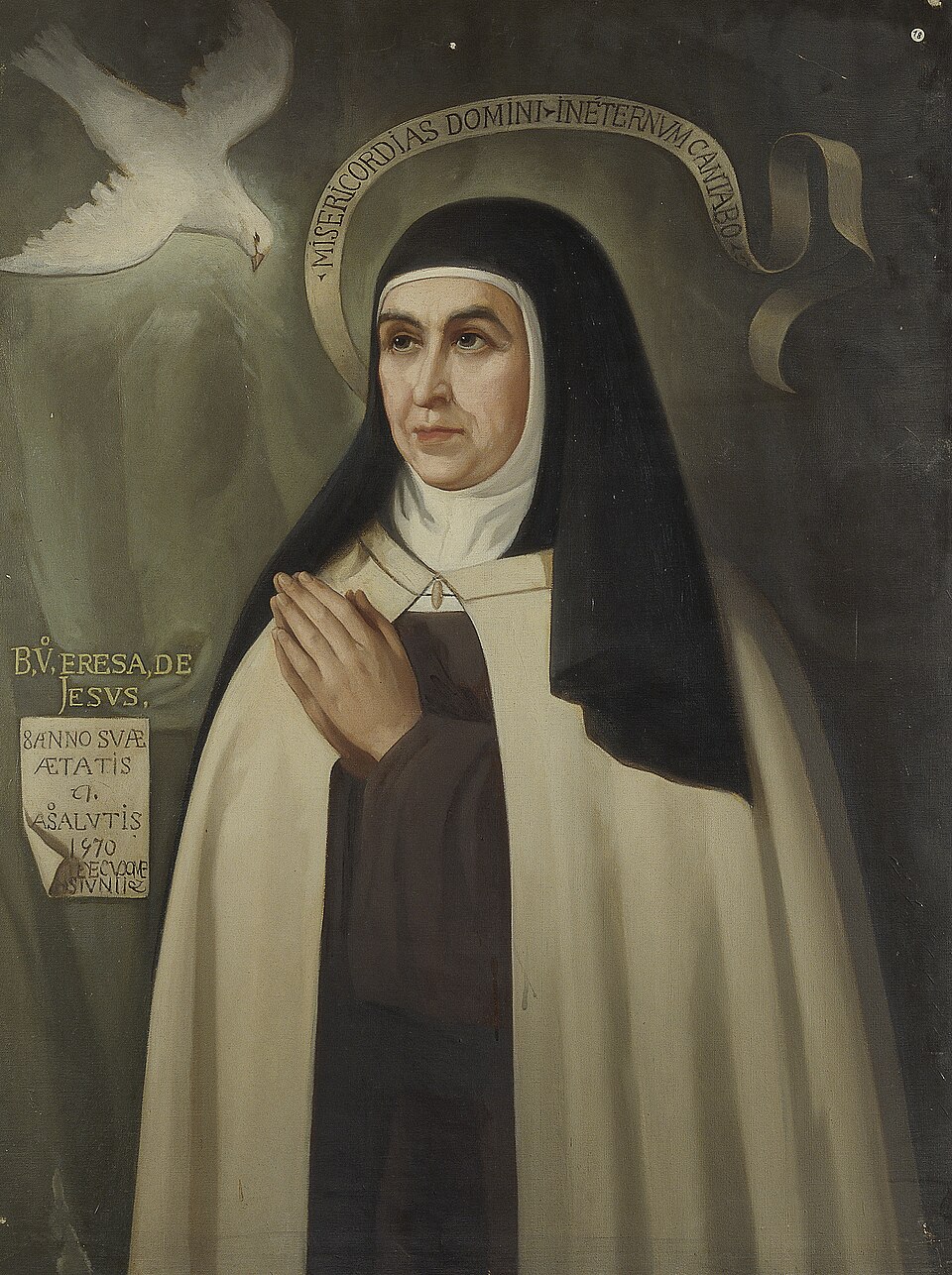
Sus obras, como "El castillo interior" y "El camino de perfección", se han hecho famosas por su profundidad y sabiduría, convirtiéndola en una escritora mística significativa en la historia cristiana. Reconociendo sus inmensas contribuciones a la Iglesia y su profunda espiritualidad, el Papa Pablo VI proclamó a Teresa de Ávila Doctora de la Iglesia el 27 de septiembre de 1970. Este prestigioso título reconoce sus enseñanzas ejemplares y profundas intuiciones espirituales que continúan inspirando a cristianos en todo el mundo. Santa Teresa de Ávila suele representarse como una monja vestida con el hábito tradicional de carmelita descalzo. Otras representaciones la muestran con el corazón atravesado por una flecha, sostenido por un ángel. También puede aparecer sosteniendo un corazón atravesado, un libro, una cruz o una pluma, simbolizando su escritura.
Además, existen representaciones de ella recibiendo un mensaje de una paloma, simbolizando la inspiración divina. Sus fiestas se celebran el 15 de octubre y el 27 de agosto, conmemorando la transverberación de su corazón. Santa Teresa de Ávila falleció el 4 de octubre de 1582 en Alba de Tormes debido a causas naturales. Falleció en los brazos de su secretaria y estrecha amiga, la Beata Ana de San Bartolomé. Su cuerpo permanece incorrupto y se conserva como reliquia en Alba. Su corazón también muestra signos de transverberación, la atravesada del corazón, y se exhibe para veneración. Su impacto y santidad la llevaron a ser beatificada por el Papa Paulo V el 24 de abril de 1614 y canonizada por el Papa Gregorio XV el 12 de marzo de 1622. Santa Teresa de Ávila es considerada santa patrona contra males corporales, dolores de cabeza, enfermedades, la muerte de padres, labradores de encaje, trabajadores de encaje, personas en necesidad de gracia, personas en órdenes religiosas, enfermos, y fue especialmente honrada durante la Jornada Mundial de la Juventud 2011. También es ampliamente...
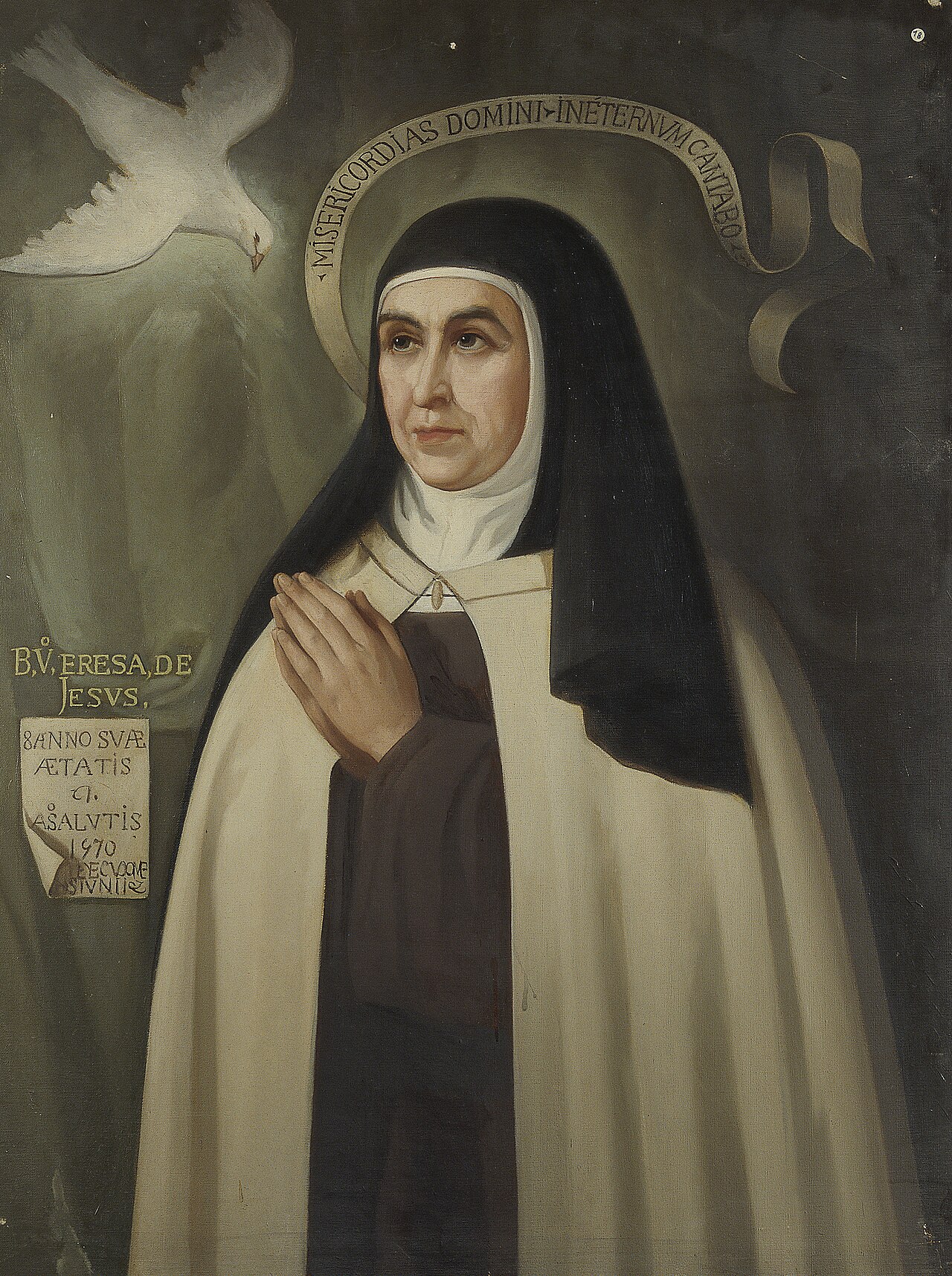
Wikimedia Commons
También se celebran el 15 de octubre
¿Conoces una gracia o milagro atribuido a Santa Teresa de Ávila?
Reportar una Gracia o Milagro