Saint
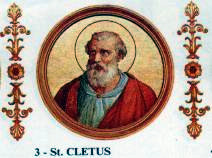
Saint Anacletus (Cletus)
The Chair of Peter carries a weight that transcends the individual who occupies it.
Biography
The Chair of Peter carries a weight that transcends the individual who occupies it. In the lineage of the bishops of Rome, one figure stands out for the sheer proximity to the foundation of the Church. This is the legacy of the pontiff known variously as Anacletus or Cletus. He occupies a singular place in ecclesiastical history as the second to rule the Church of Rome directly after the Apostle Peter. This succession establishes a tangible link to the apostolic age, anchoring the authority of the See of Rome in the very ministry of Christ's chosen vessel. The continuity of leadership from the Prince of the Apostles to this immediate successor remains a cornerstone of the claim to apostolic succession.
Historical records from this era are notoriously sparse, yet the liturgical memory of the Church preserves his name. Traditionally, he is recognized as having succeeded the Prince of the Apostles. While specific details of his early life remain obscured by the mists of time, the significance of his office cannot be overstated. He served during the formative years of the Christian community in the capital of the Empire. The transition of leadership from Peter to this second ruler occurred c. the late first century, a time when the faith was spreading through the Mediterranean world under the shadow of imperial power. The stability provided by a recognized leader in Rome became essential for the unity of the faithful during these critical decades of expansion.
The variation in his name, appearing as both Anacletus and Cletus in different traditions, reflects the fluidity of early nomenclature and the challenges of recording history in the first century. Regardless of the specific designation used, the identity remains the same: the successor to the Fisherman of Galilee. The continuity of the Petrine ministry was crucial during these formative years. As the Church faced external pressures and internal consolidation, the authority maintained by this second bishop ensured that the structure laid by the Apostles was not disrupted.
Little is known of his personal virtues, his writings, or the specific circumstances of his end. However, the existence of a commemoration in the liturgical calendar attests to the reverence held for him by the faithful across the centuries. The Church remembers him not for elaborate biographical anecdotes, which are absent, but for the faithful fulfillment of the duty entrusted to him. He is remembered as a steward of the apostolic succession, ensuring that the authority given by Christ to Peter was maintained without interruption. The silence surrounding his life is a testament to the era's lack of documentation rather than a lack of sanctity.
Ultimately, the second bishop of Rome serves as a bridge between the apostolic age and the developing institutional Church. His legacy is one of continuity and fidelity. By holding the keys after Peter, he guaranteed the survival of the Church's structure during its most vulnerable years. The faithful continue to honor this successor to Peter, acknowledging that the foundation laid by the Apostles was guarded by those who followed, even when history does not record their names with the detail afforded to later generations. His commemoration stands as a reminder that the Church is built upon a succession of witness, beginning with Peter and continuing through Anacletus.
Know of a grace or miracle attributed to Saint Anacletus (Cletus)?
Report a Grace or Miracle