Saint
Saint Emidio
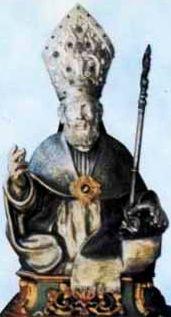
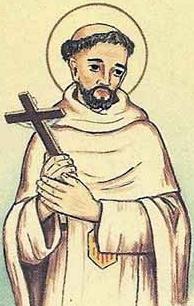
Saint Emidio, known in Latin as Emygdius, was the first bishop of Ascoli Piceno and a martyr of the early Church.
Biography
Saint Emidio, known in Latin as Emygdius, was the first bishop of Ascoli Piceno and a martyr of the early Church. He is venerated throughout Italy and beyond as the patron saint invoked against earthquakes, a devotion that has endured for over three centuries.
According to his hagiography, Emidio was born a pagan in the city of Trier in what is now southwestern Germany, traditionally dated to c. 272. He was converted to Christianity and baptized by Saints Nazarius and Celsus. Burning with zeal for the faith, he traveled first to Milan, where he was ordained a priest, and then onward to Rome.
In Rome, Emidio lodged with a man named Gratianus on Tiber Island. There he cured Gratianus's paralytic daughter, prompting the entire household to embrace Christianity. The Roman populace, marveling at his healing powers, believed him to be a son of Apollo and carried him by force to the Temple of
Asclepius on the island. Emidio boldly declared himself a Christian, tore down the pagan altars, and smashed a statue of Asclepius to pieces. Pope Marcellus I consecrated him bishop and sent him to evangelize the city of Ascoli Piceno in the Marche region of central Italy.
On his journey to Ascoli, Emidio continued his missionary work, converting many along the way. Tradition recounts that he struck a cliff face and caused water to gush forth from the rock, a miracle reminiscent of Moses in the desert. Upon arriving in Ascoli Piceno, he established the Christian community and served as its first bishop.
The Roman governor of the region, Polymius, attempted to persuade Emidio to abandon his faith. Polymius even offered the hand of his own daughter, Polisia, in marriage. Instead, Emidio baptized Polisia as a Christian in the waters of the River Tronto, along with many other converts. Enraged, Polymius personally beheaded Emidio at the site now occupied by the church known as Sant'Emidio Rosso. Three of his companions were martyred alongside him, traditionally dated to c. 303 during the persecution under Emperor Diocletian.
A remarkable legend holds that after his decapitation he picked up his own severed head and carried it to a spot on a nearby mountain where he had previously constructed an oratory. This site became the church and catacomb complex known as Sant'Emidio alle Grotte, where his remains were originally interred.
The cult of Saint Emidio is ancient, with churches dedicated to him documented as early as the eighth century. His fame as protector against earthquakes was firmly established in 1703, when a devastating earthquake struck the Marche region but miraculously left Ascoli Piceno unharmed. His veneration crossed the Atlantic during the colonial period, where he was invoked against earthquakes in Spanish and Portuguese territories. He is perhaps most famously depicted in Carlo Crivelli's masterpiece The Annunciation, with Saint Emidius (1486), now in the National Gallery in London.
Also remembered on August 5
Know of a grace or miracle attributed to Saint Emidio?
Report a Grace or Miracle