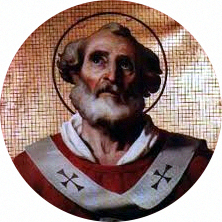
Saint Hormisdas
Feast Day
August 6
Biography
In the turbulent landscape of the early sixth century, where ecclesiastical unity was fractured by political maneuvering and theological dispute, one shepherd stood as a beacon of stability and diplomacy. His remarkable legacy is not defined by miracles of the physical realm, but by the profound spiritual and political work of restoring communion. As a bearer of peace, he succeeded in reconciling the schism of Acacius in the East and in the West, healing a wound that had threatened the very cohesion of the universal Church.
The historical context of his pontificate was marked by deep division. For decades, a rift had existed between the See of Rome and the Patriarchate of Constantinople, a conflict rooted in the aftermath of the Council of Chalcedon and the subsequent political entanglements of the Byzantine Empire. This division, known historically as the Acacian Schism, had left the faithful in the East and West unable to share in the Eucharist together. The Church was a body divided against itself, and the restoration of this bond was a task requiring immense fortitude and diplomatic skill.
He assumed the burden of the papacy during this critical juncture, serving as the Bishop of Rome at Saint Peter’s. From this historic seat of apostolic authority, he worked tirelessly to bridge the gap between the two halves of Christendom. While details of his early life remain obscured by the mists of time, his tenure is distinguished by a singular focus on unity. He did not seek to impose authority through force, but rather to negotiate a return to orthodoxy and communion through the power of reconciliation. His efforts were recognized as a triumph of the Church, successfully bringing the divided churches back into a state of shared faith and fellowship.
The success of his mission is often cited as the primary reason for his enduring veneration. In an era where popes often faced persecution or political exile, his ability to achieve a diplomatic resolution at the highest levels of the Church and State set him apart. The reconciliation he achieved was not merely a political settlement; it was a spiritual healing that allowed the faithful to once again worship as one body under the successor of Saint Peter.
Historical records regarding his personal origins are sparse, and much of his early biography is lost to the annals of time. However, the significance of his work is preserved in the liturgical memory of the Church. His deposition, or the commemoration of his passing, is marked with reverence, acknowledging the peace he brought to the universal Church. He is remembered not for the specific dates of his birth or the names of his predecessors in the line of succession, but for the tangible outcome of his labor: the end of a long schism.
To be a bearer of peace in such a fractured age was a rare gift. The Church of Rome, situated at Saint Peter’s, stood as the anchor of this peace. Through his leadership, the walls of division that had separated the East from the West were dismantled, allowing for a restoration of the faith that had been compromised by years of discord. While the specific theological negotiations that secured this peace are not fully detailed in the surviving briefs, the result is clear and enduring.
In the quiet dignity of his service, he demonstrated that the authority of the papacy could be wielded for the sake of unity rather than dominance. Though the full extent of his personal virtues may be veiled by the passage of centuries, his achievement stands as a cornerstone in the history of the Church. He remains a model of diplomatic sanctity, a Pope whose greatest miracle was the restoration of peace among the faithful.
Heraldry & Devotional Emblems
Documentary record: no verified arms linked yet. Read the heraldry standard.
Know of a grace or miracle attributed to Saint Hormisdas?
Report a Grace or Miracle