Saint
Saint Findan of Rheinau
The image of a man sealed within stone, separated from the world by a wall yet bound closer to the Divine than any observer, stands as a testament to the profound resilience of the human spirit.
Biography
The image of a man sealed within stone, separated from the world by a wall yet bound closer to the Divine than any observer, stands as a testament to the profound resilience of the human spirit. This is the legacy of Findan, a monk whose life was defined by a journey from the depths of human cruelty to the heights of contemplative solitude. His story begins not in the peace of a monastery, but amidst the chaos of the Viking Age, where the threat of Norse raiders cast a long shadow over the British Isles.
Tradition holds that he hailed from Leinster, Ireland, though the precise circumstances of his birth remain obscured by the mists of the ninth century. His early years were shattered by tragedy when Norse raiders attacked, murdering the rest of his family and dragging him into captivity. He was forced into slavery in the Orkney Islands, a harsh existence that tested his faith and endurance. Yet, through divine providence, he managed to escape this bondage, finding his way north to Scotland. From there, a pilgrim’s heart drove him southward, initiating a long pilgrimage to Rome, Italy. This journey was not merely a physical trek but a spiritual quest for solace and direction following the devastation of his youth.
Upon reaching the Eternal City, he entered the religious life as a monk at Farfa Abbey in Sabina. Here, he found stability and community, serving the Church in the heart of Italy. However, the call to a more rigorous asceticism eventually drew him further north to the banks of the Rhine. He settled at Rheinau Abbey in Switzerland, where he would spend the remainder of his days. For twenty-two years, he lived as a monk and hermit within the abbey walls.
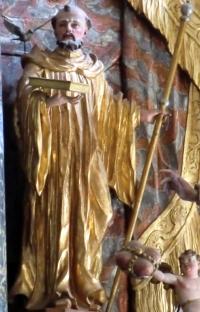
The final chapter of his life was marked by an extraordinary act of renunciation. For the last seventeen years of his life, Findan lived as a walled-in recluse. This radical seclusion was not an escape from the world, but a total immersion into prayer, offering his suffering and isolation as a sacrifice for the Church and the world. In an era often defined by political instability and external threats, his internal fortress became a sanctuary of grace. His iconography reflects this dual nature of his pilgrimage and his solitude; he is depicted with a pilgrim’s staff, signifying his long journey from slavery to Rome, and a dove, representing the peace and the Holy Spirit that guided him through his trials.
He breathed his last in the year 879 at Rheinau Abbey, passing away from natural causes. His physical remains were later enshrined in the Fintansaltar within the abbey church, where they continue to inspire the faithful. The Church commemorates his life and witness on the 15th of November. Through his trials of slavery and his gift of seclusion, Findan remains a beacon of endurance, reminding believers that even the most broken circumstances can be transformed into a vessel of grace. His life stands as a powerful narrative of how divine providence can guide a soul from the darkness of captivity into
Know of a grace or miracle attributed to Saint Findan of Rheinau?
Report a Grace or Miracle