Saint
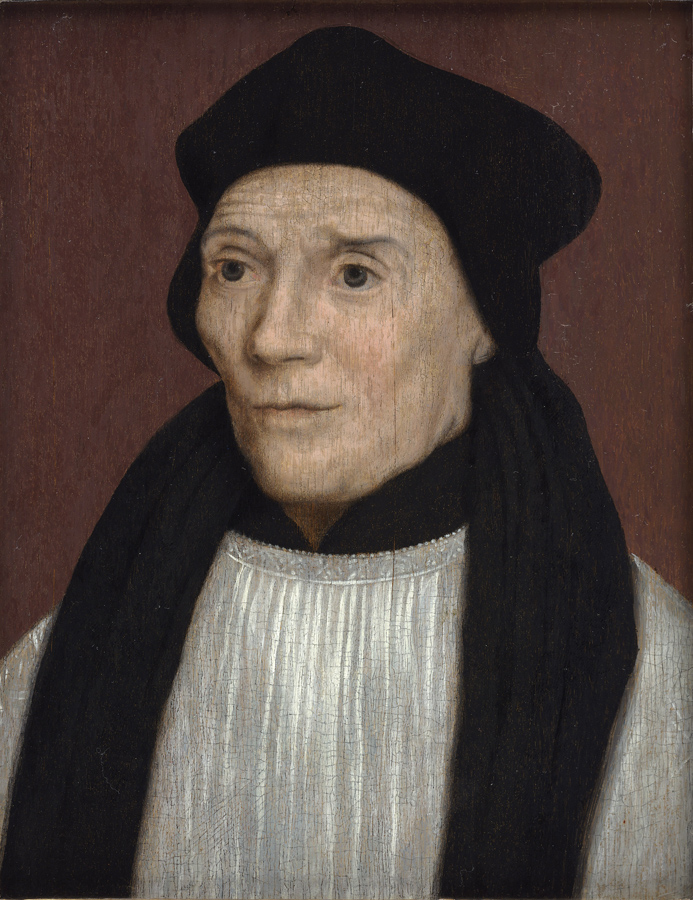
Saint John Fisher
Bishop of Rochester and martyr, beheaded at the Tower of London, 1469-1535
Early life
John Fisher was born at Beverley on 19 October 1469 to a wealthy Yorkshire family.[1] At 14 he entered the University of Cambridge and took a degree in theology; at 22 he was ordained a priest by exception and became confessor and chaplain to Countess Margherita Beaufort, the future grandmother of Henry VIII.[1] Together they founded Saint John's and Christ's College, of which he became vice-chancellor, requiring the study of Latin, Greek or Hebrew, the languages of the Bible; a Latinist, he began studying Greek at 48 and Hebrew at 50.[1]
Ministry
In 1504 he was consecrated Bishop of Rochester, one of the smallest and poorest dioceses in the country, which he never wished to leave and which he called his poor bride.[1] In 1523 he entered the struggle against the Lutheran Reformation as it spread to England, standing beside the king in defence of the primacy of the Church of Rome, and published the De veritate corporis et sanguinis Christi in Eucharistia.[1]
Persecution
His relationship with Henry VIII broke down when the king divorced Catherine of Aragon, whose confessor he was, to marry Anne Boleyn without the Pope's dispensation, and the bishop refused the king's request to go against the Roman Pontiff.[1] Ordered to swear loyalty to the king, he answered: only as far as the law of Christ allows.[1] In 1534 Henry VIII prepared the Act of Supremacy, to which all bishops were to submit; he refused, was arrested on 13 April and imprisoned in the Tower of London, and the see of Rochester was declared vacant.[1] In prison, during the trial in which he was condemned to death, he found an old friend, Thomas More, a lay jurist also condemned for refusing to swear obedience to the king; though not in the same cell, they supported and comforted each other.[1]
Death and recognition
In Rome the Pope decided to create him a cardinal in an attempt to save him, but Henry VIII refused to release him.[1] On 22 June he was woken by the guards and told that his execution was set for ten o'clock that day; on the scaffold he refused loyalty to Henry VIII three more times.[1] Thomas More followed him a few days later, and the Catholic Church keeps the memory of the two saints on the same day.[1] He was beatified on 29 December 1886 by Pope Leo XIII.[1] He was canonised on 19 May 1935 by Pope Pius XI.[1]
Follow the evidence
Sources and notes
- John Fisher
Dicastery for the Causes of Saints · Italian
Accessed 2026-09-05
Editorial notes
Translated and condensed from the Dicastery's official Italian profile by an automated pass on 2026-09-09; identity matched on the death date and name; editorial review pending.
This is an AI-assisted draft prepared from the sources above. Its citations identify its evidence; they do not replace a historical review.
The inherited biography
The earlier biography for this record.
Read the inherited biography
Saint John Fisher, also known as John of Rochester or John Fisher of Rochester, was born in 1469 in Beverly, Yorkshire, England. He displayed great intellectual prowess from an early age and went on to study theology at Cambridge University. He received his degrees in 1487 and 1491, establishing himself as a learned theologian. Following his studies, Fisher became a parish priest in Northallerton, England, serving from 1491 to 1494. During this time, he gained a reputation for his exceptional teaching abilities. His talent was recognized by the Church, and he was appointed as the Proctor of Cambridge University. In 1497, Fisher became the confessor to Margaret Beaufort, the mother of King Henry VII. This position further solidified his standing within the Church.
In 1504, he was consecrated as the Bishop of Rochester, England. In his role as bishop, Fisher worked tirelessly to improve the standard of preaching in his diocese and was known for his piety and commitment to religious education. In addition to his ecclesiastical responsibilities, Fisher also held prominent positions in academia. He served as the Chancellor of Cambridge and was appointed as the tutor to the young King Henry VIII. Fisher's exceptional speaking and writing abilities contributed to his esteemed position within both the Church and academic circles. However, in 1527, the course of Fisher's life dramatically changed. He was tasked with studying the issue of King Henry VIII's marriage and became a target of the king's wrath when he defended the validity of the marriage and rejected Henry's claim to be the head of the Church in England.
As a result of his opposition to Henry's actions, Fisher was imprisoned in 1534 without trial. He was held captive for 14 months, during which time he remained strong in his convictions and unwavering in his faith. While imprisoned, Fisher's reputation and dedication to the Catholic faith were acknowledged by Pope Paul III. In 1535, he was created a cardinal in recognition of his saintly life and unwavering resistance to the religious changes occurring in England. On 22 June 1535, Saint John Fisher was martyred. He was hanged, drawn, and quartered on Tower Hill, Tyburn, London, England. His body was buried in the churchyard of All Hallows, Barking, England, without any religious rites or burial shroud. His head was displayed on London Bridge for two weeks as a warning to others, before being thrown into the River Thames.
Today, relics of Saint John Fisher can be found in Saint Peter's Church in the Tower of London. He was beatified on 29 December 1886 by Pope Leo XIII and canonized on 19 May 1935 by Pope Pius XI. Saint John Fisher is revered as a courageous defender of the Catholic faith. He is the patron saint of the Diocese of Rochester, New York, and is often depicted as a cardinal with an axe nearby, a cardinal with his hat at his feet, or a cardinal with worn, haggard features.
Wikimedia Commons
Also remembered on June 22
Know of a grace or miracle attributed to Saint John Fisher?
Report a Grace or Miracle