SaintPre-Congregation
Saint Onuphrius
Saint Onuphrius, also known as Onuphrius of Egypt, was a revered hermit who lived in the desert near Thebais, Upper Egypt.
Biography
Saint Onuphrius, also known as Onuphrius of Egypt, was a revered hermit who lived in the desert near Thebais, Upper Egypt. Born in the 4th century, little is known about his early life, but what is certain is that he dedicated himself to a life of extreme solitude and privation in order to imitate the lifestyle of Saint John the Baptist. For an astonishing seventy years, Onuphrius resided in the barren desert, seeking solace and communion with God. He dwelled in a humble cell, eschewing worldly comforts, and subsisted solely on the fruits of a date tree and a palm-tree located near his dwelling. His austere diet reflected not only his devotion to the divine but also his desire to emulate the lifestyle and trials of the biblical prophet he admired.
During the Middle Ages, the story of Saint Onuphrius gained popularity, especially among monks. His portrayal as a hermit clad only in long hair and a loincloth made a lasting impression on people's minds. Consequently, he became closely associated with weavers due to his distinctive appearance, and painters often depicted him with a key attribute: a crown at his feet. Furthermore, some artistic depictions of Saint Onuphrius also feature an angel delivering the Eucharist or bread to the holy hermit. This representation symbolizes the divine sustenance that Onuphrius received during his long years of solitude. Another notable depiction is that of him being buried by two lions, although this story was occasionally confused with the burial of Saint Jerome. Saint Onuphrius passed away around the year 400, leaving an enduring legacy of asceticism and devotion.
Upon his death, his body was lovingly interred by Saint Paphnutius, who had journeyed to Onuphrius seeking guidance and a confirmation of his own religious calling. When Paphnutius buried Onuphrius in a hole in the mountainside, to his astonishment, the hole instantaneously disappeared. This miraculous occurrence was seen as confirmation of the saint's holiness even after his passing. Although Saint Onuphrius was never officially canonized in the modern sense, his veneration predates the formal process of canonization. He is honored as a saint in the Pre-Congregation era and is venerated on his feast day, which falls on June 12th. Saint Onuphrius holds a special place as the patron saint of Centrache, Catanzaro, Italy; Paterno, Avezzano, Italy; and Sutera, Italy. Furthermore, he is revered as the patron saint of weavers, who draw inspiration from his solitary and ascetic lifestyle. Today, the memory and example of Saint Onuphrius continue to inspire faithful Catholics around the world to seek a life of simplicity, dedication, and spiritual communion with God.
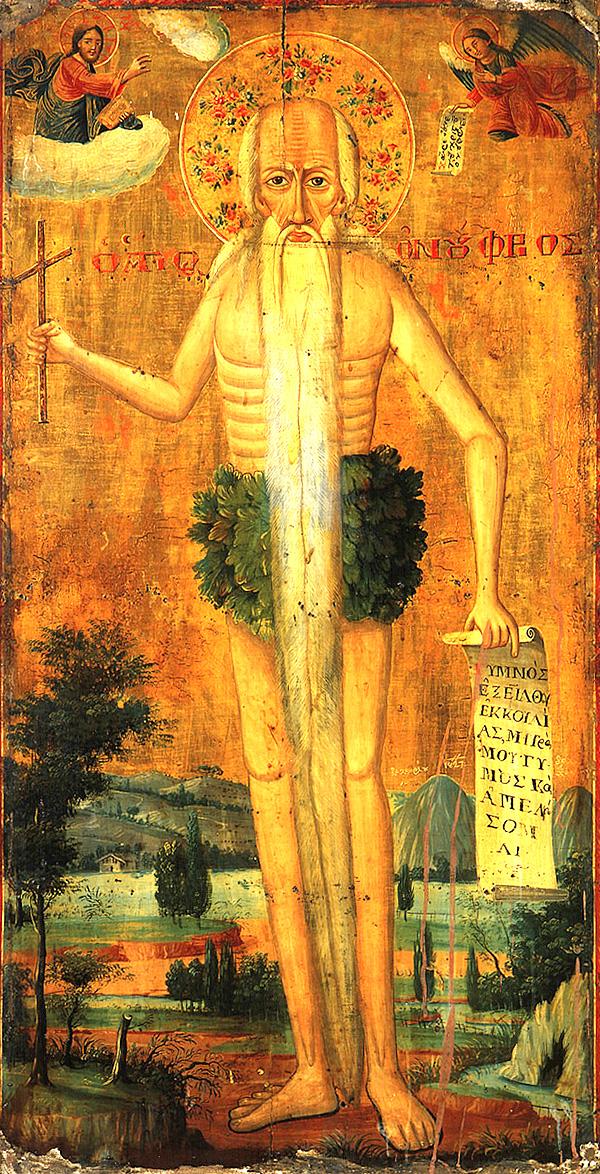
Wikimedia Commons
Also remembered on June 12
Know of a grace or miracle attributed to Saint Onuphrius?
Report a Grace or Miracle